

“Do I contradict myself?
Very well then I contradict myself,
I am large, I contain multitudes.”
Walt Whitman
Recently, a senior colleague sent me an email that asked: “Is this still you?”.
I was rushed at work and irritated at not being able to master a simple power-point process for a lecture, so reverted to my default setting- my frustration morphs into anger and irritability and when rushed but obstructed, I become flippant, self-deprecatory or sarcastic. I had missed a deadline to submit a paper to an important journal. One of my patient had escalating risk. On their own, each was a routine matter to resolve in everyday life of a clinical academic. Together they brought out my least attractive qualities. So I replied, part jokingly and partly in anger: “Yes. Who else might it be? Unless you are asking a deeper question, like the Ship of Theseus?”.
Within an hour I had submitted the paper, sorted out the slides, and the patient had been admitted. As the adrenaline rush faded, I started worrying that my response had been childish and facetious.
The senior colleague was obviously checking whether the old email address he had for me was contemporaneous. He might have had a serious message to convey, confidential and important enough not to send to a wrong email address. I felt foolish. I wrote a feeble apology about flippancy being my default mode when overwhelmed.
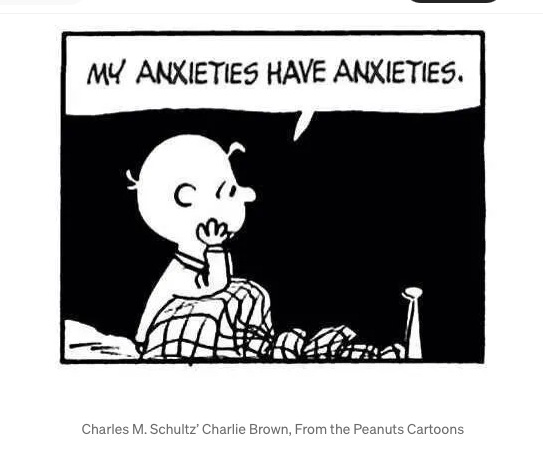
My colleague reassured me in his return email that there was nothing to apologise for; I had made him smile. But my suspicion that I had mis-spoken lingered far longer than the occasion merited. I worried for a few moments, then got worried that I was worrying about a trivial matter and then started worrying that the matter could not be trivial if I was worrying about it. It reminded me a Peanuts cartoon where Charlie Brown admits that even his worries have worries (figure widely available on the net)
Triggering in psychiatry
People with unstable bipolar disorders can often relapse at small disturbances; a full-blown manic episode does not require a catastrophe to occur, but just perturbation of daily rhythm, a broken night’s sleep, a badly phrased email or a perceived humiliation can appear catastrophic and derail recovery. The psyche is not always undone by the storm; it is often undone by the misplaced word.
My colleagues question stayed with me though. Within that deceptively simple request for a verification of my institutional email identity was a metaphysical trapdoor. Another way of understanding the question was that colleague asking me: Are you the same person I used to know?
The Ship of Theseus
The puzzle of the Ship of Theseus is an ancient inquiry into identity and change, traditionally traced back to Plutarch. The story follows Theseus, the mythical Athenian hero, who returned from Crete after killing the Minotaur. The Athenians preserved his ship for generations. As the wooden planks decayed, these were replaced with newer, stronger timber.
Eventually, every original piece - every beam, every plank, every nail - was gone, replaced by a newer one. A question then arose: Is this still the Ship of Theseus?
The easy answer is yes. The ship maintains continuity of name, form, function, and history.
But there is an argument for “No”. If no original material remains, it is merely a replica standing in the harbour.
Thomas Hobbes added a sharper edge to the dilemma. He imagined a person collecting every discarded, rotting plank and reconstructing a second ship from the original matter. Now there are two ships: the continuously maintained vessel and the one made of the original wood. Which now is the “real” ship?
This question is intriguing because it is not about ships. It is about selves, our sense of selfhood, our bodies, our memories, our relationships, nations, cultures, societies and civilisations. If something changes bit by bit over time, at what point does it stop being itself? If everything is changed and replaced, what remains of the original?


A Collection of Clocks
The email from my colleague was literally legitimate because I had not seen him in a long time. Atom by atom, molecule by molecule, my body was different from the one he had last met face to face.
The popular claim that the body replaces itself every seven years is an attractive half-truth. The body does not renew itself according to a single calendar; it is not one clock. It is a collection of clocks.
The human body replaces roughly 330 billion cells each day, approximately one percent of its total mass daily. This does not mean every cell is gone every hundred days; it means blood and gut cells dominate the turnover while other parts remain stubbornly present.
The lining of the intestine, for example, is replaced within days. This makes sense when you consider the environment these cells inhabit: they are continually exposed to digestive enzymes, acids, microbes, toxins, and the mechanical abrasion of whatever we eat. These are cells built with replacement in mind.
Neutrophils, the most abundant white blood cells in the circulation, have an even more fleeting existence. Their lifespan is measured in hours to days. They are the emergency responders of the immune system: rapidly produced, rapidly deployed, and rapidly replaced.
Platelets, essential to blood clotting and the repair of damaged blood vessels, circulate for roughly seven to ten days before being cleared and replenished.
Our skin turns over on the scale of weeks, although the exact rate changes with age, illness, injury, and environment. The surface we present to the world is therefore not quite as permanent as it appears.
Red blood cells survive much longer, around 120 days. After travelling hundreds of miles through the circulation and repeatedly squeezing through tiny capillaries, ageing red cells are eventually removed, principally by the spleen and liver, while the bone marrow quietly replaces them.
Even bones, which feels like the very definition of permanence, change. Bone is continuously broken down and rebuilt. Its turnover is slow, but the process never really stops. The skeleton is not simply the scaffolding we were issued in adulthood; it is a tissue in continual conversation with hormones, muscles, nutrition, mechanical stress, and age.
And then there are neurons.
Many neurons in the cerebral cortex can remain with us for a lifetime.
This creates a striking biological contrast. Some parts of us disappear and are replaced within hours. Others turn over over days, weeks, months, or years. And some of the cells through which we perceive the world, remember our past, and construct a sense of self may accompany us from early life into old age.
So the body is neither permanently the same nor completely replaced. The body is not an object. It is an unfolding event.
If my chemical constitution is different now from then, the question “is this still you?” is profound. It is about what maintains our sense of continuity, if everything that constitutes us materially has been replaced.
The Mechanism of Memory
The obvious answer to what holds us together is memory. I remember my colleague as a person I met the very first time and the last time I saw him. I remember some conversations, some settings, and some topics under discussion. I can stich these fragments from my memory into a ‘whole’ that I think of him as a person.
Neuroscience provides the mechanics of this operation. The hippocampus binds experience into memory, and the cortex stores and reorganizes those memories over time. The default mode network is active when we think about ourselves, remember the past, or imagine the future. It constructs the inner narrative by which we recognize ourselves as continuous.
However, autobiographical memory is not a passive archive; it is a living reconstruction. Every act of remembering is a rewriting. The “me” who remembers the past is not retrieving a file from a cabinet. He is recreating it, placing the past inside the needs, fears, griefs, and hopes of the present. Memory does not merely preserve identity; it composes it moment to moment.
If all I am is a story called “me” produced by my brain, the answer to who am I feels incomplete. It explains the mechanism but misses the mystery. If I am only a combination of atoms, why does continuity feel so intimate, self-evidently true, and personally charged?
Patterns of Concern
Materialists argue that continuity is not a substance but a pattern. They say the body changes, but the organization- the form of the ship- persists. Evolution probably gave us the experience of continuity because organisms that remember danger, kinship, and debt survive better than those that do not. A creature that wakes without a sense of self might be free, but it would soon be dead. While this explains why we have a sense of self, it does not explain what holds the self together from the inside.
Eastern traditions offer a different subtlety. The Upanishadic question, “Who am I?” is not asking for a resume or a personality profile. It asks what remains when those identifications are set aside. The Buddhist doctrine of anatta (no-self) suggests that what we call the self is not a fixed, permanent entity. It is a composite, a process of “dependent arising” where body, feeling, perception, and consciousness aggregate and dissolve. The “I” is a convenience, perhaps necessary, but not a final truth.
Who knows?
I am not clever enough to answer the question definitively. I know that I am not the same person who met my colleague years ago. I have lost loved ones. I have grown older. I have become bald, and my hair is grey. I write a Substack column to understand life, which may be wisdom or vanity. One could call these changes superficial. My face has changed, but my being remains. But we cannot step outside ourselves completely to examine that being. We are both the observer and the observed; the ship examining its own planks.
Perhaps “I” is not a thing at all, but a continuity of concern. It is a loyalty to certain memories, a pattern of loves and losses, and a set of recognitions that survive even as matter changes. It is a story told by the body, revised by the mind, interrupted by emotion, and still signed in the same hand.
So, when my colleague asked, “Is this still you?” I gave him a joke. But the honest answer is: I do not know. And yet, I am still the one replying.
Beautifully done. It made me think of Antonio Damasio’s account of the self as a process rather than a fixed entity: a momentary sense of being here, now, continually refreshed against the background of bodily feeling and autobiographical memory.
Love it.