

All photographs by the author, with permission from his children
Every event in the floral calendar had taken place with immemorial punctuality and tragic rapidity. All the full-blooded flowers of Summer had long since come and gone, with their magic faces and their souls of perfume. ~Richard Le Gallienne, “The Green Friend,” October Vagabonds, 1910
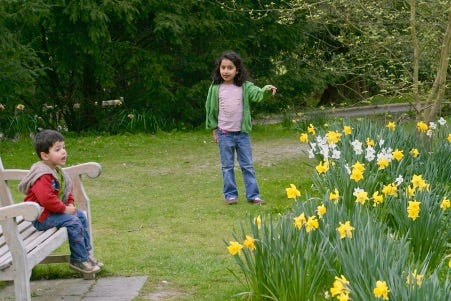
Every spring, at roughly the same time, the daffodils arrive.
I do not notice the first one. For some reason, a crocus bloom captures my attention as soon as it appears. Snowdrops are beautiful and so aptly named. But they escape my attention too. Never a crocus.
But when the daffodils appear in splendid profusion, they suddenly overwhelm my visual orientation. A verge I have driven past all winter without interest suddenly appears populated with angled yellow heads, repeated sometimes precisely geometrical and lined, but more often, irregularly arranged. One day they were not there and suddenly they insist on being noticed. On a stretch of road to work, not far from home and before the worries and distractions of the day have stolen my attention, suddenly, there they are. They intrude into my restless mental preoccupation with an insistence that I would find irritating in a fellow human being.
This spring I had a strange yet convincing idea. The daffodils were smiling at me. That’s why I couldn’t ignore them.
Do not smile at strangers
When I was planning to move to England, an Indian friend familiar with the ways of the English told me to avoid discussing politics and not to smile at people while travelling in the tube. I realised on my very first day in London that the involuntary squeeze of intimacy that the London tube required an armour of studied indifference to the presence of others, and a wilful obduracy about not looking another in the eye. Smiling is an invitation to intimacy. In sexually segregated societies, women simply do not make eye contact with unfamiliar men, let alone smile at them. In my adolescence there was a risqué phrase that we sniggered over in school lavatories: hassi to phassi (literally, if she smiles at you, you’ve netted her).
The daffodils definitelysmile at me as I drive past them crowding the verge.
Even as I write this, I feel the need to qualify or justify it. It sounds bonkers. We, coldly rational human beings, equipped with marvels of modern science, know that plants do not smile. How can they? They do not possess musculature, or faces, or intent. They are subject to wind, to light, to soil. My best possible justification is that I am being poetic. I don’t really mean it. I am trying to describe an ineffable human emotion by attributing it to a ‘senseless’ entity.
And yet! When I drive past the rows upon rows of daffodils, I am convinced that they are smiling at me. Not that they are beautiful. Not that aesthetically their colour scheme is so well coordinated with the light of the season. Not that they are merely present. I am sure they are smiling at me. I know they are.
I could say they wave. That would be defensible. They sway in the wind, their stems bend, their heads move in synchrony. All easily explained. The breeze bends them with air pressure. Waving requires intent. Motion within the laws of physics is, well, just the immutable and universal laws of Newtonian physics. Apply pressure to a body and it will move. No other explanation needed.
But I do not experience the daffodils waving at me. They smile at me. I smile back.
Am I psychotic?
The lovely flowers embarrass me,
They make me regret I am not a bee –
~Emily Dickinson, 1864
I am aware, even as I set this down on paper, that this is a dodgy claim. It is not one I would defend in a Court of Law or under oath. If a patient were to say to me that flowers smiled at them, I would not accept it at face value. I would ask further questions. I would want to know whether this perception was part of a wider pattern.
Patients with psychosis often feel persecuted. The world is sending them ominous signals. Everything around them is charged with significance. The biomedical explanation is that increased activity of a particular chemical in the brain makes an individual attribute ‘salience’ to everyday perceptions. That chemical imbalance is a cause of psychosis. But for the individual who feels that they see red cars in the neighbourhood far too often, and this must mean that the intelligence services are spying on them, the experience is real and the explanation understandable. Their conviction in what we call persecutory delusions is absolute. The ‘external’ evidence to confirm this, however, is not. The world does not rearrange itself in response to the intensity of one’s belief. A strong feeling does not make the attribution of that feeling real.
I am not, to the best of my knowledge, in the throes of a psychotic breakdown every spring when daffodils appear. That sentence, too, is not as stable as it appears. It assumes that I would be able to recognise such a state in myself. That my capacity for self-observation would remain intact. That I would not, in the very act of being unwell, lose access to the criteria by which I judge external reality. My very first task, when I meet a patient with psychosis for the first time, is to help them feel understood. Everyone so far has denied what seems to them to be true. I tell them that I believe them honestly and believe their honesty. That’s where the therapeutic relationship begins.
We rely, perhaps too easily, on the idea that we can step outside our own experience and evaluate it. That there exists some internal vantage point from which we can declare this is real, this is not. This is mine, this is imposed. This is perception, this is projection. In practice, the boundary is less secure. We all carry strange and unusual ideas. But if we can function within the constraints of society accepting a shared external reality without suffering or causing suffering, we are autonomous beings, free to choose what to believe. Patients with psychosis have their lives, relationships and their own sense of self fragmented and sometimes destroyed, where a psychiatrist has to step in to restore the relationship with a shared reality.
I return, then, to the daffodils. They seem to smile. I experience them as smiling. I do not believe, in any straightforward sense, that they possess the capacity to smile. And yet, the experience persists. So, I ask myself a simpler question.
What is a smile?
“A smile is the shortest distance between two people” attributed to Victor Borge, Danish comedian and pianist

We recognise a smile without effort. Young children distinguish between a smiling face that seems to welcome and a face that does not. We do not need to be instructed in the mechanics of it. The recognition is immediate. But when closely examined, the smile is not a simple phenomenon. There is, for instance, a distinction between what is called a Duchenne smile and its less convincing counterpart. The Duchenne smile involves the contraction of muscles around the eyes as well as the mouth. The cheeks lift. The eyes narrow slightly. There is a sense, difficult to articulate, that the expression is not confined to a single part of the face.

The non-Duchenne smile, by contrast, involves the mouth alone. The lips turn upward. The rest of the face remains unchanged. It is the smile of politeness, of obligation, of social compliance.

Most of us can tell the difference. We are not taught to do so. We do not, in the moment, analyse which muscles are engaged. We simply know. A genuine smile is felt as genuine. A forced one is not.
There have been experiments in which participants are shown images of faces and asked to distinguish between these two types of smiles. They do so with a degree of accuracy that exceeds chance. When asked how they arrived at their judgement, they struggle to explain. The knowledge is tacit. It does not present itself as a set of rules.
There is, in other words, something about a smile that we recognise without knowing how we recognise it.
There are also experiments that proceed in the opposite direction. Rather than observing smiles, researchers attempt to induce them. One of the more well-known involves asking participants to hold a pencil between their teeth, thereby forcing the muscles of the mouth into a position that resembles a smile. Participants then rate their mood. Those whose faces are arranged in this way report a slight improvement.
The implication is that the relationship between expression and feeling is not unidirectional. We do not only smile because we are happy. We may also become happier because we are smiling or attempting to do so.
If we step back from the human face, we find that the function of the smile is not confined to our species. Other animals possess behaviours that serve similar purposes, even if they do not resemble a smile in form. Dogs wag their tails. The wag is not a simple movement. It varies in speed, in amplitude, in direction. It can signal excitement, affiliation, readiness to engage. It can also signal anxiety. The meaning is context dependent. And yet, for those who live with dogs, the wag is often read as a kind of greeting. A sign of recognition.
Among primates, expressions that resemble smiling have been observed. Chimpanzees, for instance, display what is sometimes called a “play face,” in which the mouth is open and the lips are retracted. In other contexts, a similar expression can signal submission. The same configuration of muscles carries different meanings depending on the situation.
What unites these behaviours is not their appearance but their function. They regulate interaction. They signal something about the internal state of the animal to others. They facilitate social cohesion or at least reduce conflict.

The smile therefore is not merely a pattern of muscle contraction. It is a signal. It operates within a system of communication. It has a role. But there is a vast gulf between chimpanzees and daffodils on every measure, other than that they are both life forms. Very little else in common between them. So does a smile have a role in the life of plants?
Are plants emotional?
Plants do not possess a nervous system, not one that we know of. They do not have brains. They do not, as far as we can tell, have experiences in anything like the way animals do. And yet, they are not inert. They grow toward light. They send roots toward water. They respond to damage. They allocate resources. They reproduce. My grandmother and mother told me that plants were as sentient as other beings, including humans.
Plants such as the Mimosa pudica close their leaves when touched. The movement is rapid enough to be observed without special equipment. It gives the impression, if one is inclined to such impressions, of withdrawal. In northern India the plant is called chhui mui, literally touch me and I will die, emphasising the delicate sensitivity of a dainty and shy bride. There are others, like the Venus flytrap, that close around an insect when triggered. The movement is purposeful and serves a function. It captures prey.
We are cautious, rightly, about attributing intention to these behaviours. We tell ourselves that all this is the result of biochemical processes, of evolutionary pressures, of mechanisms that do not require anything like awareness. And yet, the language we use begins to strain. We speak of plants “seeking” light, “avoiding” shade, “competing” for resources. These are metaphors. They borrow from the vocabulary of organisms that possess minds. They are, strictly speaking, inaccurate.
If a plant bends toward light, we can describe the differential growth of cells on one side of the stem. We can trace the hormonal pathways. We can measure the rate of change. All of this is correct. None of it, however, captures the immediacy of the movement as we perceive it.
So, do plants have emotions? The question is usually answered in the negative. Emotions, as we understand them, require a nervous system of a certain complexity. They involve representations, evaluations, bodily states.
And yet, if we consider what plants do, we find analogues, of a sort, to some of the drives we recognise in animals. They move toward what sustains them. They withdraw, in some cases, from what harms them. They invest energy in reproduction. We might speak of hunger, thirst, or a drive to reproduce as ‘animal instincts.’ So why can’t these be ‘life instincts’ that animals share with plants?
What we do not find, or do not think we find in plants is anything that corresponds to joy. There is no obvious plant behaviour that signals an immediate, outward expression of something like pleasure. There is no plant equivalent of a smile.
But do the daffodils smile?
At this point, I am less interested in resolving the question than in understanding why it arises. Why this perception, rather than another? Why smiling, rather than waving, or simply existing?
One possibility is that the smile is entirely mine. That I am projecting onto the daffodils a human need and then responding to it as if it were being fulfilled. A loop of my own making. This would not be unusual. We do this with animals, with objects, with weather. We see faces in clouds. We attribute moods to rooms. We speak to machines. I talk to my car, computer, and camera, especially when they don’t do what I say. I strongly recommend that everyone should talk to plants.
I like the idea that the daffodils smile at me. To see a smile is to be invited into a certain kind of relation. It lowers my defences. It increases my gratitude towards life and being alive. It allows for a moment of ease and comfort when I would otherwise be in turmoil about the past or the future. If I experience the daffodils as smiling, I may, in turn, find myself smiling back. The exchange is asymmetrical, perhaps entirely one-sided. And yet, the effect is not negligible.
Daffodils and mortality
Robert Herrick, a 17th-century poet, wrote a poem To Daffodils with these lines that have stayed with me since I first read it:
“Fair daffodils, we weep to see
You haste away so soon…”
The poem is about brevity. About the speed with which things appear and disappear. The daffodils do not last. Nor does anything else. Everything is temporary and transient. Arriving foretells perishing. Wordsworth describes a “host” of daffodils, “fluttering and dancing in the breeze.” The movement is noted. The repetition. The abundance. And later, the memory of them, which “flashes upon that inward eye” (I wandered lonely as a cloud). Wendell Berry writes of entering “the peace of wild things.” The movement here is inward. The external world provides something that the internal world lacks.
I do not wish to make too much of these references. They are not evidence. They do not resolve the question. They simply indicate that others have found, in encounters with the non-human world, something that resists simple description.
I return, again, to the road. To the morning. To the small, repeated encounter. The daffodils will be there each morning. They have no need of me. They do not alter their behaviour in response to my presence. They will continue to grow, to open, to fade, whether I pass by or not.
But when I do pass, something happens. I see them. They seem to smile. I feel something in response. An inner ease. A moment of joy. A momentary feeling that this moment is enough. I do not have to harden my armour to fight the day. It does not last. It is not transformative. It does not alter the course of the day in any dramatic way.
I could correct the perception. I could remind myself, each morning, that plants do not smile. That what I am experiencing is a projection. That the appropriate response is to note the beauty of the flowers and move on.
It is not that I believe, in any literal sense, that the daffodils are smiling. It is that the distinction between literal and non-literal seems, in this context, less important than it might otherwise be.
But it is there. There is an exchange. It is silent. It is brief. It is not subject to verification.
Every morning, they smile at me. And I smile back. Whether the smile originates in them or in me is, perhaps, not a question that requires an answer. The experience does not demand justification. It does not present itself as a claim about the world that must be defended. It is, rather, a small event. A moment in which something like connection is felt.
It is enough.
This is lovely. It takes something as simple as seeing daffodils on the roadside and turns it into a warm, thoughtful reflection on how small moments in nature can lift us and make us feel more connected.