

Satgur Nanak pargatia, miti dhundh jag chanan hoya.
Guru Nanak appeared in the world. The fog dissipated. All was illuminated.
All photographs by the author

Last week I was travelling in a taxi with a Sikh driver. He was devout. We started talking about his life, his longing for home, and his Sikh beliefs. He recited the line above about Guru Nanak, emphasising the word “dhundh” (fog) and said that his religious belief dissipated the fog in his mind. I was rushed as usual and paid no attention till later that evening when it struck me that he had said something profound.
The words themselves come from the writings of Bhai Gurdas, a Sikh scholar and poet who lived in the late sixteenth and early seventeenth centuries. They are found in the first of his Vaars, or ballads, in the 27th Pauri(stanza). Bhai Gurdas was a contemporary of several of the Sikh Gurus and served as the principal scribe of the original compilation of the Adi Granth, the scripture that would become the Guru Granth Sahib. His writings are among the earliest interpretations of the teachings of Guru Nanak.
I have been thinking about these words, particularly the distinction between darkness and fog. I think that this distinction contains a profound insight into the human condition, into suffering, and perhaps into the purpose of spirituality itself.
But first, a little about Guru Nanak.
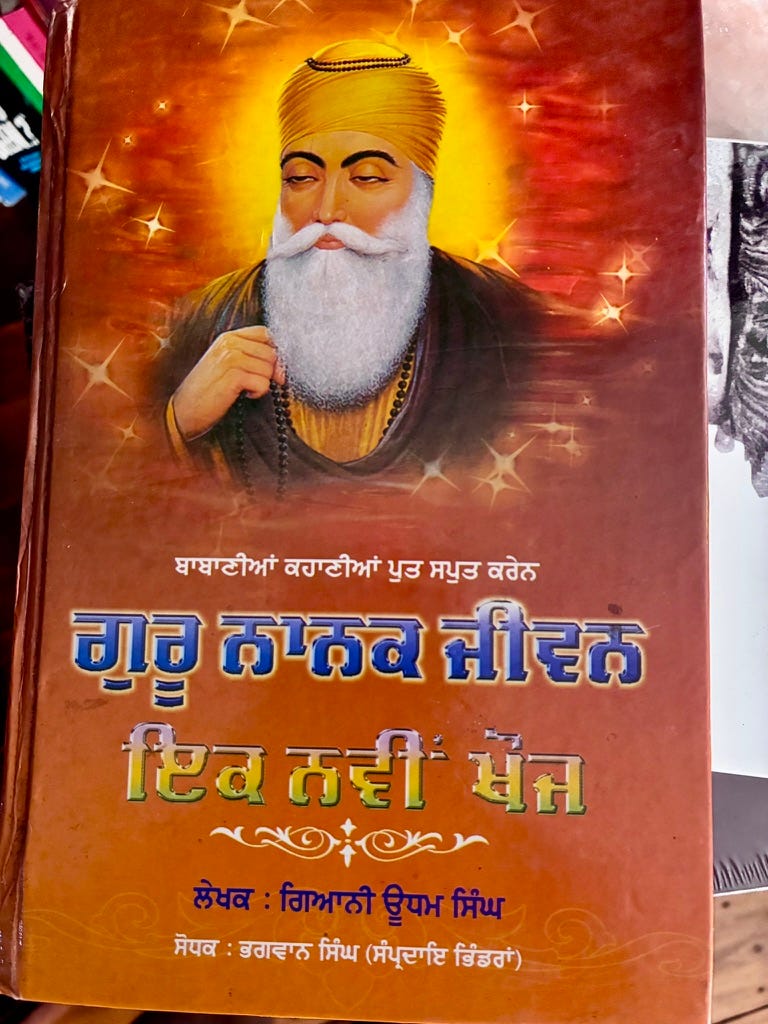
Guru Nanak and his world
Guru Nanak was born in 1469 in Talwandi, a village in Punjab, now known as Nankana Sahib in Pakistan. He died in 1539, having spent much of his adult life travelling, teaching, questioning religious orthodoxies and challenging the social conventions of his time.
He lived in a world divided by religion, caste and gender. Northern India was dominated politically by Muslim rulers, while much of its population followed Hindu traditions. Religion was deeply embedded in everyday life, but it was also associated with elaborate rituals, superstition, priestly authority and rigid social hierarchies. The caste system determined people’s standing in society. Women were considered inferior to men. Hindus and Muslims were separated by beliefs and practices which frequently obscured their common humanity.
Nanak challenged all of this. He rejected the idea that God belonged to any particular religion or that one human being could be intrinsically superior to another. His message was strikingly simple: there is one universal divine reality, present in all creation and accessible to every human being. One did not need priests, rituals, pilgrimages or elaborate theological knowledge to experience the divine. What mattered was how one lived. And one need not renounce the world to find the divine. One could be in the world and still be spiritual.
Nanak travelled extensively, traditionally accompanied by his Muslim companion and musician, Bhai Mardana. He communicated his teachings through poetry, music, conversation and example. Towards the end of his life, he settled in Kartarpur, where he established a community founded on worship, honest work and sharing. He restarted his life as a farmer.
His teachings were revolutionary in their simplicity. Which this brings me back to darkness and fog.
Darkness is not fog

There is a fundamental difference between darkness and fog. Darkness is the absence of light. Its remedy is straightforward. Light a lamp, switch on a torch, open the curtains, and darkness disappears. You do not need to struggle against darkness. You do not need to push it away. You simply introduce light.

Fog is different. Anyone who has driven through dense fog on a winter morning will recognise the problem. Switching on your headlights does not necessarily make things clearer. Indeed, putting on the full beam can make visibility worse. Instead of illuminating the road ahead, the light seems to come back at you, producing a dazzling white wall. The more light you shine into the fog, the less you may be able to see.
Why is this? The explanation lies in elegant physics.
Fog consists of tiny droplets of water suspended in the air. It forms when moist air cools sufficiently for water vapour to condense into liquid droplets. These droplets are individually almost invisible, but collectively they transform the way light travels through the atmosphere. In clear air, light travels relatively unimpeded. In fog, the droplets scatter the light in different directions.
The phenomenon is described by the physics of light scattering, particularly Mie scattering, which occurs when particles are comparable to or larger than the wavelength of visible light. Some light is scattered sideways, some backwards, and some continues forward. The result is that much less light from distant objects reaches our eyes in a way that preserves a clear image. At the same time, light scattered towards us creates a luminous veil that reduces contrast.
A powerful headlight may therefore illuminate the fog immediately in front of us rather than the road beyond it. This is why fog lights are positioned low and directed towards the road. The solution is not simply more light, but using light more intelligently. Strictly speaking, light does penetrate fog. It is scattered and attenuated rather than completely blocked. But the practical consequence is the same: the presence of light does not guarantee the ability to see.
This is a fascinating distinction. Darkness is a problem of absence. Fog is a problem of interference. In darkness, we cannot see because there is no light. In fog, we cannot see even though light is present.

I wonder whether this is what makes Bhai Gurdas’s metaphor so profound. Perhaps the great problem of human existence is not the absence of knowledge, wisdom or truth. Perhaps it is that our perception is obscured by everything that stands between us and that truth. Our prejudices, our beliefs, our identities, our fears, our desires and our attachments. We may be surrounded by light and yet be unable to see. And sometimes, in our attempts to understand the world, we simply turn up the headlights.
Nanak and human suffering
Nanak dukhiya sab sansar.
Nanak, the whole world suffers.
These words appear in the Guru Granth Sahib, on Ang 954, in a composition of Guru Nanak. The observation is remarkably similar to the starting point of Buddhist philosophy: suffering is an inescapable part of human existence.
As a psychiatrist, I have spent much of my professional life trying to understand human suffering. We have developed increasingly sophisticated ways of describing it. We have diagnostic classifications, psychological theories, neuroscience, genetics, neuroimaging and an expanding range of treatments. All of these have contributed to our understanding, and some have transformed lives. Yet suffering remains universal (essay in suffering here).
We suffer because of loss, illness, disappointment, loneliness and uncertainty. We suffer because reality does not conform to our expectations. We suffer because of things that happen to us, but also because of the meanings we attach to those events. We suffer because we want things we do not have, because we fear losing the things we possess, and because we struggle to accept the impermanence of everything around us.
And perhaps we suffer because we cannot see clearly.
Our minds are filled with assumptions, memories, expectations, beliefs and fears. We construct narratives about ourselves and other people and then begin to experience those narratives as reality. We mistake our interpretation of the world for the world itself. In other words, we live in fog.
And perhaps what we need is not more information, more explanations or even more intellectual illumination. Perhaps we need the fog to clear.
Spirituality without religion
I believe that Guru Nanak understood spirituality primarily as a personal pursuit.
This does not mean that he advocated withdrawal from society. Quite the contrary. His spirituality was grounded in everyday life, in work, family, community and service. But the transformation he sought began within the individual. Nanak did not set out to create the organised religion we now recognise as Sikhism, with its distinctive institutional structures, ceremonies and visible identity. He did, however, establish a community of followers (Sikh literally means to learn), and the tradition that followed him developed through the teachings of nine successive Gurus.
Over the following two centuries, this community underwent a remarkable transformation. It faced growing political hostility and persecution, including the executions of the fifth Guru, Arjan, in 1606 and the ninth Guru, Tegh Bahadur, in 1675. In 1699, Guru Gobind Singh, the tenth Guru, established the Khalsa, giving the Sikh community a distinctive collective identity and a commitment to resist oppression. The uncut hair, the turban and the other visible symbols associated with initiated Sikhs became important expressions of this identity.
The transformation was not simply a military response to persecution. It was also the continuation of an evolving religious and ethical tradition. Nevertheless, persecution and the need for collective self-defence played a profound part in shaping the Sikh identity that we recognise today.
It is worth remembering that almost two centuries separated Nanak’s birth from the creation of the Khalsa. And I wonder whether, in concentrating on the external manifestations of religious identity, we sometimes lose sight of the extraordinary simplicity of Nanak’s original message.
The Bhakti tradition
Guru Nanak emerged within the broader intellectual and spiritual world of the Bhakti and Sant movements that flourished across medieval India.
Bhakti means devotion. At its heart was the idea that a direct and personal relationship with the divine was available to everyone, regardless of caste, status, gender or religious education. Saints and poets such as Kabir, Ravidas and Namdev questioned ritualism, caste distinctions and religious authority. They spoke in the languages of ordinary people rather than restricting spiritual knowledge to the learned and privileged.
Nanak’s teachings shared much with this tradition, particularly its emphasis on devotion to a formless God and its rejection of social and religious hierarchies. His philosophy was nevertheless distinctive and developed into a tradition of its own.
What interests me most is the underlying rejection of artificial differences between human beings. Nanak was not asking whether Hinduism was superior to Islam, or Islam superior to Hinduism. He was asking why such distinctions should matter when the same divine reality was present in every human being.
He rejected the idea that women were spiritually inferior, that birth determined human worth, or that ritual observance was evidence of goodness. The divine did not belong to the priest, the scholar, the ascetic or the wealthy. It belonged to everyone. And if we recognise the same divine presence in every human being, how can we justify treating one person as less worthy than another? This was not merely a theological proposition. It had radical social implications. It challenged the structures through which human beings establish hierarchies, exclude others and justify inequality.
Nanak’s spirituality was therefore deeply personal, but its consequences were profoundly social. A change in how we see ourselves must necessarily change how we see others. Perhaps this is what it means for the fog to dissipate.
My own journey
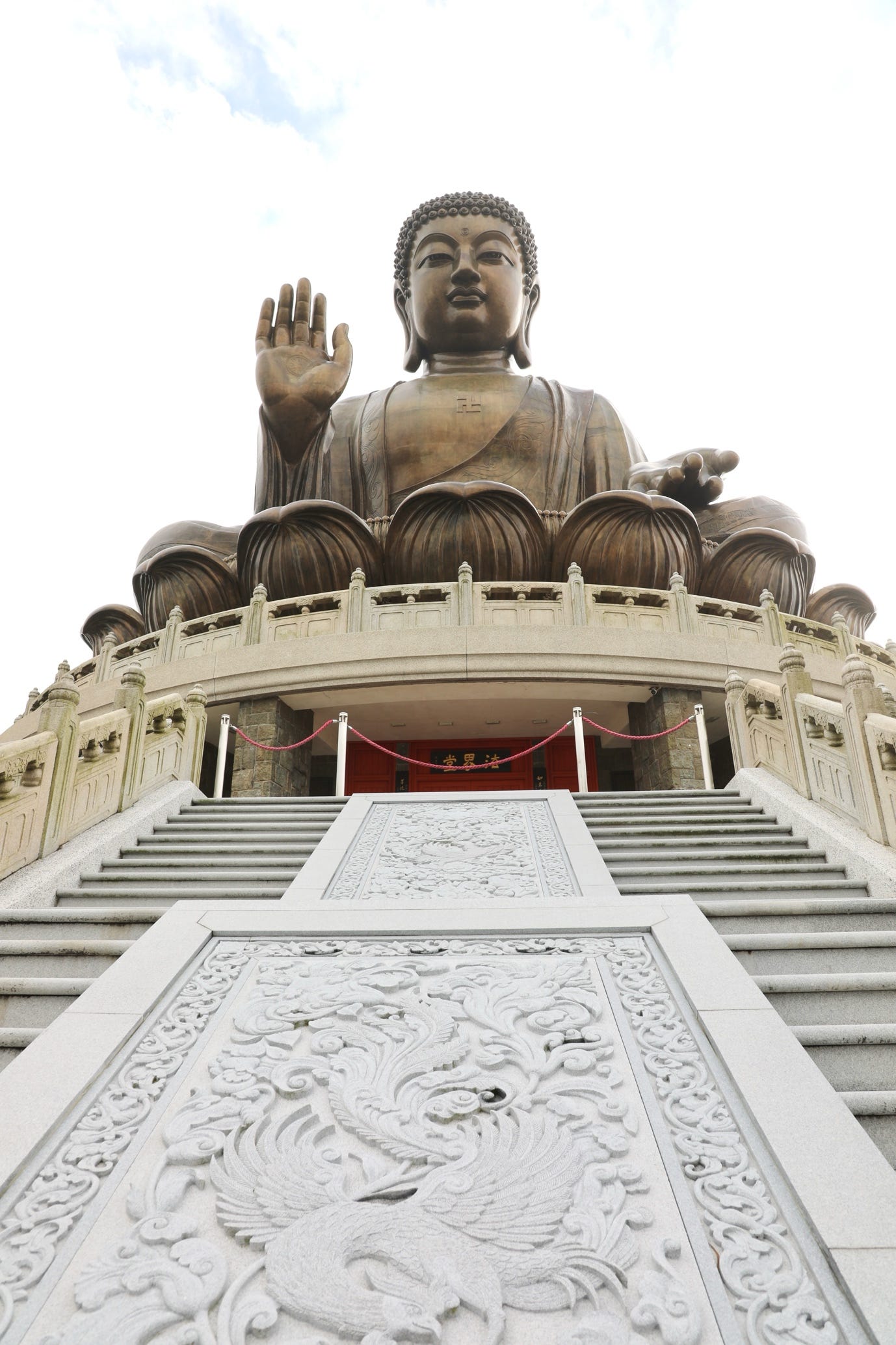
For much of my adult life, I considered myself a devout atheist. I use the word devout deliberately. My atheism was not simply an absence of religious belief. It was a strongly held conviction, supported by what I regarded as reason, science and a healthy scepticism towards supernatural explanations. Religion appeared to me to be a collection of beliefs, rituals and superstitions, many of which had little basis in evidence and some of which had caused considerable human suffering.
I saw no reason to believe in God. Yet, curiously, I had forgotten something important. When I was 23, I had an experience that I can only describe as revelatory. It was an experience that challenged my ordinary understanding of reality and left a profound impression on me at the time. And then, somewhere in the course of my life, I put it aside. I have described it here, as noesis – a stairway to heaven.
Perhaps it did not fit comfortably with the intellectual framework I subsequently developed. Perhaps my scientific training and professional identity gave me ways of understanding the world that seemed more coherent, more respectable and more defensible. Whatever the reason, the experience receded from consciousness.
I am not suggesting that such an experience constitutes evidence for the existence of God, at least not in the conventional scientific sense. Nor am I suggesting that religious explanations should replace scientific ones. But I have become increasingly interested in the distinction between what we know and what we experience, between the explanations we construct and the reality those explanations are intended to describe.
Science is an extraordinarily powerful method for understanding the natural world. But scientific knowledge and personal meaning do not necessarily answer the same questions. And intellectual certainty can sometimes become its own kind of fog.
I wonder whether, in my certainty that I understood the world, I had lost sight of something important. Perhaps the question is not whether one believes in God. Perhaps the more interesting question is what it means to live a good life. And here, I find myself returning to Guru Nanak.
A prescription for a flourishing life
The essence of Guru Nanak’s practical philosophy is often summarised in three simple injunctions:
Naam Japo. Kirat Karo. Vand Chhako. (Remember God. Earn an honest living. Share what you have with others).
These three phrases are a traditional summary of his teachings rather than a single verbatim quotation from his writings.
Naam Japo is usually translated as remembering or meditating on the divine name. But it can also be understood more broadly as cultivating awareness of something greater than oneself, recognising the interconnectedness of existence and resisting the tyranny of the ego. Kirat Karo means earning one’s living through honest work. It affirms the dignity of labour and the importance of contributing to the world through one’s actions. Spirituality is not an excuse to escape the responsibilities of ordinary life. Vand Chhako means sharing what one has with others. It recognises that human flourishing cannot be separated from the wellbeing of other human beings.
Remember God. Do good. Share with others. Very little theology is required to appreciate the wisdom of this prescription. One need not subscribe to a particular religion. One need not accept elaborate metaphysical propositions. One need not even believe in God in the conventional sense to recognise the value of living with awareness, integrity and generosity.
There is a great deal of contemporary scientific interest in the ingredients of a flourishing life. We study wellbeing, happiness, meaning, purpose, relationships, compassion and prosocial behaviour. We have d sophisticated theories and methods to investigate these questions. Yet here, in six or seven simple words, is a remarkably concise prescription for living well.
Naam Japo. Kirat Karo. Vand Chhako.
Cultivate awareness. Live honestly. Share with others.
Perhaps the deepest insights into human flourishing are not necessarily complicated. Perhaps they do not require elaborate theories, complex rituals or membership of an organised religion. Perhaps what we need is not more light, but clearer vision.
We have accumulated an extraordinary amount of knowledge about ourselves and the universe. We have illuminated aspects of existence that would have been unimaginable to people living five hundred years ago. And yet we continue to suffer, to divide ourselves into competing groups, to create hierarchies of human worth, and to pursue things that often leave us dissatisfied.
We have more light than ever before. But the fog has not lifted.
Five centuries after Guru Nanak, I find myself wondering whether his greatest contribution was not to provide answers to the mysteries of existence, but to suggest a different way of seeing. A way of seeing beyond religious labels, social divisions and the insistent demands of the ego.
A way of recognising our common humanity. And a way of living that makes life better, not just for ourselves but for the people around us.
Perhaps that is what Bhai Gurdas meant when he wrote:
Satgur Nanak pargatia, miti dhundh jag chanan hoya.
Guru Nanak appeared. The fog dissipated. The world was illuminated.
Not simply that a new light had appeared in the world.
But that the fog which prevented us from seeing the light that was already there had begun to clear.
I rather like that enlightenment arrived by taxi, while you were in a hurry to be somewhere else. Perhaps our everyday haste creates a fog of its own, which an unexpected encounter can briefly lift.