

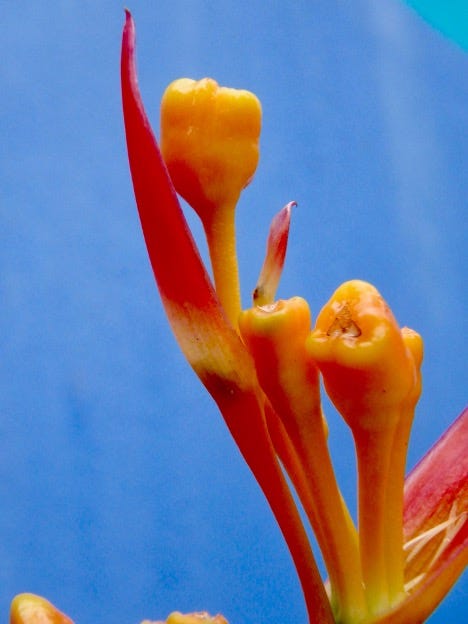
Yesterday I walked around the garden with a pair of secateurs.
This extraordinary summer has made everything bloom at a pace I have never seen. Roses, dahlias, salvias, cosmos, lupins, gladioli all seem to open overnight. But the heat is unforgiving. Leave a flower two days too long and the stem collapses before your eyes, leaving behind scorched leaves, petals burnt at the edges, and seed pods where there used to be colour.
So, I do what every gardener must. I deadhead. It feels cruel. I am telling the plant: as long as you give me beauty, I will look after you. Then, off with your head. Merciless. Rather like human relationships. We think we give more than we take in relationships, till we are asked to truly give, when we walk away. If I could, I would have let my blooms flourish in another being’s life as long as they lasted, and then let go without bitterness when the season ended. But we are not as wise as the seasons.
A week later the plants answer the cuts with another bloom. My lupins are on their third output this summer already.
Ageing out of season
I have reached the stage of life where I catch myself saying, “Things were better in my day.” I say it about music. I say it about phones. I say it about attention spans. Then, one morning, cutting away at something in the garden, it dawned on me that the world probably hasn’t deteriorated nearly as much as I have convinced myself it has. What I am noticing is not the decline of civilisation. It is self-pity dressed up as social commentary. The decline that I see in the world around me is simply a reflection of my own decrepitude. It is the ageing of one man. As a young man I never passed a mirror without admiring myself in it. Nowadays I avoid mirrors, because I see a wrinkled stranger looking back. It would be funny were it not so poignant.
Most young people I meet are kinder than when I was at their age. Less arrogant. More emotionally literate, more accepting of people who are different from them, and a good deal less interested in pretending they have certainty about things nobody has certainty about. The world hasn’t run out of goodness. I have simply aged out of the season of life in which I first met it.
Renunciation or engagement
My youngest leaves home this September. I am not going to call it the empty nest syndrome, because it isn’t a syndrome. A syndrome is a clinical presentation with many underlying causes. The empty nest has only one cause, emptiness. For over twenty-five years I have known exactly who I was because somebody needed me. A father, a partner, often just a driver, very often a wallet, a shoulder, an opera partner, a shared poetry lover. But needed. And then, one day nobody needed me anymore.
Many people have heard about the new-Freudian Erik Erikson; very few have heard about Sudhir Kakar, the Indian psychoanalyst. Erikson and Kakar met in Ahmedabad while he was working on his book about Gandhi. Erikson is the psychoanalyst every psychology student still learns from; his stages of development are practically scriptural authority. Kakar taught Erikson about the ancient Indian idea of the four stages of life, the ashramas. Freudian development centred around infancy and adolescence. Erikson learnt that in the Indian tradition adulthood was not simply middle age stretched out for another thirty years, but a series of transformations, each one with a developmental task.
There are four stages. Brahmcharya (a student’s disciplined, celibate life); Grahsthya (the householder); vanaprastha(forest dweller) and Sanyaasa (renouncing the world) I am in vanparastha. But I still live an urban life. I am full of energy and vitality. I have no interest in disappearing into a forest, literal or otherwise. If anything, I want to become more present to the world than I have ever managed to be.
The multiplicity of now
There is a wonderful Korean film - Spring, Summer, Fall, Winter… and Spring Again- that follows a monk through life inside the four walls of a floating monastery. A child joins the monk. He becomes a young man. The young man falls into desire, and then into something like ruin. Regret arrives. And then, without any announcement, spring comes around again. Not because nothing was lost. Nothing is undone. Life refuses to end with any one season.
There’s a line of e. e. cummings: i who have died am alive again today. And a poem by Louis MacNeice, Snow, that I first read decades ago: World is crazier and more of it than we think, incorrigibly plural. He’s sitting by a fire, peeling a tangerine, spitting out the pips, and he feels: the drunkenness of things being various. I read it now and think that’s it, that’s the complaint I’ve been making about the modern world, answered in four lines written in 1935. The world was never simple. I just used to have the energy to pretend it was.
The heaviness of being
My own heart, right now, as I write this, is not entirely light. There are losses I did not choose. Dreams that ended without permission. Relationships that withered when I wasn’t looking. It would be easy to mistake the end of one season for the end of everything. But I’ve spent enough hours in this garden to know better than that.
I’ve written before about Nalanda and Ephesus, two places that were once the centre of everything and are now mostly rubble and tourists and the silence that only ruins have. That essay was about impermanence in general. Everything changes, I said. But there is a more frightening possibility. Not everything changes; some people and places stayed the same in my lifetime I changed.
Perish and grow
There’s a verse in the Bhagavad Gita: just as a person casts off worn-out clothes and puts on new ones, so the embodiedself casts off worn-out bodies and takes on others that are new. It’s usually read as being about death and rebirth, the next life after this one. I don’t think you need to believe any of that to use it. I read it now as something closer to psychology than theology.
There’s also a line from the Brihadaranyaka Upanishad that I’m not going to explain, because I think explaining it would ruin it:
From the unreal lead me to the real.
From darkness lead me to light.
From death lead me to immortality.
Yesterday I cut away another handful of dead flowers. They looked dead. Absolutely finished, the way only a dead flower can look. By next week there will be new buds where I made the cuts. Deadheading isn’t the end of flowering - it is how flowering continues. I suspect that this is true of a life as well as a rose bush. I suspect I have spent a good part of this year mistaking endings for extinctions, when they were only new beginnings.
In the depth of winter, I finally learned that within me there lay an invincible summer- Albert Camus
Your essay made me think of Tagore—first The Gardener, for obvious reasons, and then this line from Gitanjali: “This frail vessel thou emptiest again and again, and fillest it ever with fresh life.” It seems especially apt for your idea that an ending may simply make room for another flowering.