

All photographs by the author
As a lotus flower is born in water, grows in water and rises out of water to stand above it unsoiled, so I live, unsoiled by the world -Gautama Buddha
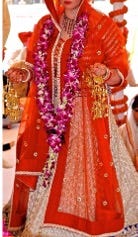
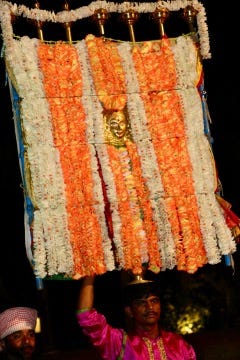
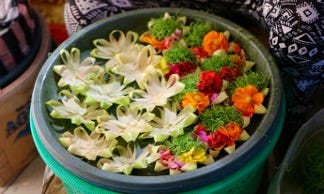
There are flowers at weddings. Flowers beside the newborn child. Flowers before gods. Flowers around photographs of the dead. Flowers laid on graves, carried to memorials, offered to lovers, placed around the necks of honoured guests.
We scatter petals when someone arrives and place wreaths when someone leaves.
Why?
In two earlier essays I wondered why we find flowers beautiful, and whether some part of that beauty might lie inmathematics: symmetry, proportion, repetition, pattern. But there is another question. Why are flowers ceremonial?
Why do we do take flowers?
It is one thing to stop beside a flower and admire it. It is quite another to pluck it, carry it somewhere, arrange it carefully and place it before another human being - a deity, a bride, a corpse. Somewhere in our history, flowers became part of a ritual. And it happened a very long time ago.
Flowers for the Dead
For many years, one of the most evocative stories in archaeology came from Shanidar Cave in Iraqi Kurdistan.
In the 1950s and 1960s, archaeologist Ralph Solecki excavated the remains of several Neanderthals at that site. Around one skeleton (known as Shanidar 4) researchers discovered unusual concentrations of pollen. Had Neanderthals buried one of their dead on a bed of flowers? The discovery became famous, and it helped transform the popular image of Neanderthals from brutish creatures into beings capable of tenderness and mourning.
More recent archaeological work has questioned the interpretation. Solitary bees nest in the cave and can carry pollen. The pollen may have arrived without anyone deliberately bringing flowers. Researchers now consider the original flower-burial explanation unlikely, though they do not exclude the possibility.
I want the Neanderthals to have brought flowers. It makes them feel fellow human. But I know that I am projecting a need rather than recognising an objective truth.
The archaeological record became clearer much later, in a cave overlooking the Mediterranean.
A Bed of Flowers
At Raqefet Cave on Mount Carmel, in present-day Israel, archaeologists discovered something extraordinary. Between approximately 13,700 and 11,700 years ago, people of the Natufian culture, while transitioning from a hunter-gatherer to a more settled lifestyle, buried their dead in a cave. They created cemeteries. And they placed their dead on beds of flowers.
Archaeologists have found impressions of stems and flowering plants pressed into the material lining several graves, accompanied by microscopic plant remains. Sage and plants belonging to the mint and figwort families appear among them. These were not merely leaves accidentally blown into a hole. The graves were deliberately lined with thick layers of fresh vegetation, including plants chosen for their colourful and aromatic flowers.
Imagine that! Thirteen thousand years ago, somebody walked out into the landscape and gathered flowers. Someone chose them. Someone carried them back. Someone arranged them beneath the body of another human being. The flowers themselves disappeared within days. Yet their impressions survived for thirteen millennia.
Beauty Is Not Enough
Perhaps we bring flowers to ceremonies because they are beautiful. But I am not sure.
Many things are beautiful. We do not place polished stones beside the dead. We do not welcome wedding guests with paintings. We rarely bring seashells to someone lying ill in hospital. Flowers occupy a particular category. They are beautiful, but their beauty is alive. And therefore doomed.
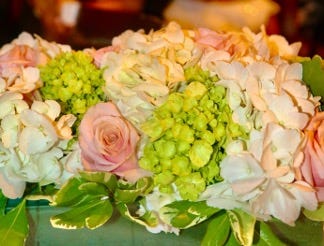
The bouquet that looks magnificent on Monday has begun to wilt by Thursday. Petals loosen. Colours fade. The water gets cloudy. What we admired begins to decay in front of us. This should make flowers unsuitable for important occasions. Instead, perhaps it makes them perfect.
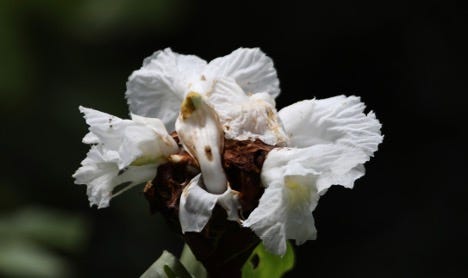
A plastic flower lasts longer. That is why it doesn’t work and may even offend one’s sensibility. A flower says: I am beautiful. Behold! I will not last. A flower’s beauty is intimately connected to its transience.
Radiohead’s Fake Plastic Trees offers a useful counterpoint to the ceremonial power of flowers. A real flower acquires its meaning precisely because it cannot last. It blooms, is offered, and then fades. The plastic tree promises permanence, but in escaping decay it also escapes being alive. Ceremonial flowers may move us because their beauty shares the condition of the ceremony itself. The moment cannot be preserved, only experienced. Their wilting is therefore not a failure of the symbol, but part of what the symbol means.
And perhaps that is also what a ceremony says. Ceremonies mark moments that cannot last. The bride and groom will grow older. The newborn child will become an adult. The person whose life we commemorate has already disappeared. The worshipper who places a flower before the divine is offering something that begins dying the moment it is plucked.
The Falling Flower
In Japan, cherry blossom has become the symbol of transience.
During sakura season, the petals fall. They do not remain on the tree to become seed or fruit. They fall, creating a brief spectacle of beauty across the ground, and then decompose. This falling is central to the beauty. The blossom that remained permanently attached to the tree would eventually cease to be blossom in any meaningful sense. Its falling completes its aesthetic purpose.
Perhaps flowers accompany our ceremonies for the same reason. We bring them precisely to those moments when life’s change becomes visible. Something begins. Something ends. Someone arrives. Someone leaves. Someone promises. Someone remembers. The flower embodies the change.
What the Natufians Knew
I return in my imagination to Raqefet Cave.
Someone kneeling beside a grave nearly thirteen thousand years ago. There were no written scriptures. No florists. No greeting cards with funny or profound sayings. Someone nevertheless had gone out and gathered aromatic plants in bloom.
There may be prosaic, less romantic explanations. Perhaps flowers masked the stench of decay and death. Perhaps they made the hard ground softer. But the graves were carefully prepared. The plants were deliberately gathered. The dead were placed upon them. The practice was repeated. More than disposal, this was meaningful disposal, a form of remembrance and goodbye.
I cannot know what that person thought while gathering sage from the hills of Mount Carmel. Thirteen thousand years later, we all recognise the instinct and the gesture.
Since that time, civilisations have appeared and disappeared. Languages and cultures have come and gone. Agriculture, writing, mathematics, empires, religions, printing press, steam engines, antibiotics, computers and artificial intelligence have appeared. Yet somewhere near the beginning of settled human life, somebody picked flowers and carried them to the dead. We still do.
Perhaps flowers do not represent any single thing. Not beauty alone. Not love alone. Not death alone. Not transience alone. Perhaps they represent attention.
For one brief moment, among all the things in the world, I noticed this flower. For one brief moment, among all the lives in the world, I noticed you. And because neither the flower nor I will remain here forever, just as neither will you, I place it before you.
That is enough.
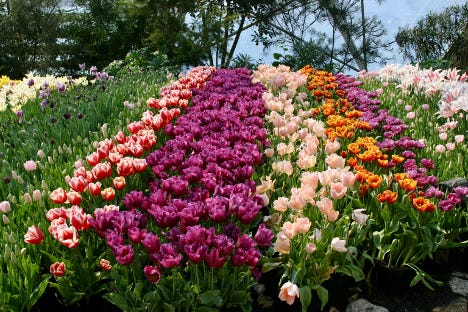
The flowers accept their transience; their photographs/paintings, rather sensibly, have secured an exemption :-)