

“The heart has its reasons that reason knows nothing of” Blaise Pascal, Pensées, fragment 277 (Lafuma)
Heart versus Head
Blaise Pascal, a contemporary of Descartes, was a scientist and a brilliant mathematician. His famous quote is often misunderstood as Pascal asserting that feelings supersede reason, and that our emotions can be so powerful that they ignore rationality. Pascal was committed to rigorous reasoning, but he also understood, as meant in this quote, that pure rationalism could not account for some deep human truths. Reason is powerful but finite in its applications. Reason itself cannot prove or disprove the existence of God; hence Pascal’s famous wager that believing in God could lead to infinite gain if God exists, but limited loss if God does not. However, if God existed and human beings did not believe, it would be an infinite loss for very limited gain. From a rational cost-benefit perspective, belief has greater advantages than disbelief. Pascal was not trying to prove God’s existence. Pascal was pointing to the limits of pure rationality in determining metaphysical truths.
The common misunderstanding of Pascal’s quote is best seen in the most basic of human dilemmas: should I listen to my head or my heart? This deceptively simple dichotomy assumes that we are driven by two distinct and clearly defined voices inside us competing for authority and driving our actions. This metaphor has persisted across cultures and time.
During the Mahabharata War (dated 1500–1000 BC, perhaps older), the Indian warrior Arjuna was torn between knowing that war was necessary but frozen from action from grief at the killing involved. In the Greek tragedy Medea (by Euripides, 431 BCE), Medea says, “I know what evil I am about to do, but anger is the master of my plans”. In the Analects (compiled 475-221 BCE), Confucius asserts that raw emotions must be cultivated into wisdom through effort. Stoicism (early 3rd century BCE) was the firmest in its conviction of emotion as erroneous judgement and passion as reason gone wrong. The stoic ideal for mental peace was apatheia, or freedom from passion.
Psyche as a rider
Sigmund Freud gave this heart-mind conflict it’s modern psychological formulation. A rider metaphor appears in a lecture later published as New Introductory Lectures on Psycho-Analysis (1933). In Lecture 31: “The Dissection of the Psychical Personality”, Freud describes the relation between ego and id using a striking image: “The ego is like a man on horseback, who has to hold in check the superior strength of the horse; with this difference, that the rider seeks to do so with his own strength while the ego uses borrowed forces.”
For Freud, the horse represented instinctual drives (id - appetites, impulses, sexual and aggressive drives), while the rider represented the ego, attempting to guide these forces. The ego is only in control as long as the id cooperates. In later writings, Freud introduced the concept of the superego, an internalised law and a voice of prohibition, shame, guilt, and ideals imposed by parents and society. Freud’s argument is unsettling. We are not the masters of our own mental spaces. Reason must govern by negotiation or defend itself from shame and guilt. Ego has no inherent sovereignty. Civilised behaviour is a precarious compromise between competing drives.

Freud was a widely read scholar. Although he did not attribute his image to any earlier writer, he was most likely aware that the metaphor of the rider appears in Plato’s Phaedrus (370 BCE), although Plato’s metaphor too was a reworking of older Greek poetic and religious imagery. According to Plato, reason (logos) is a charioteer pulled by two horses: a white (noble) horse, thymos, and an unruly black horse, epithymia. The noble horse represents moral emotions such as pride, justice, and righteous anger, has the capacity for loyalty and self-sacrifice, and is aligned with ideals such as honour. It obeys the rider willingly. The black horse represents bodily passions and desires that seek immediate satisfaction. The black horse is unruly; it tries to defy the rider and responds only to force and discipline. In Plato’s conception, the soul is tripartite - a combination of logos, thymos, and epithymia. The chariot is not inside the soul. Instead, the soul is the chariot in motion. The soul’s task is to maintain balance by skilfully guiding competing inner forces. Plato’s imagery is considered one of the earliest fully articulated models of internal psychic conflict in Western thought.
An even older chariot
The Hindu scripture Katha Upanishad (6th century BCE) offers the most detailed version of this imagery.
“Know the Self as the lord of the chariot, the body as the chariot, the intellect (buddhi) as the charioteer, and the mind (manas) as the reins. The senses, they say, are the horses; the objects of sense the paths they range over. When the Self is united with the body, the senses, and the mind, then wise people call Him the Enjoyer. He who has no understanding, whose mind is unrestrained, his senses are uncontrolled, like the vicious horses of a charioteer” Katha Upanishad, 1.3.3–1.3.4
The verse describes the human being as a chariot: the body is the vehicle, the senses are the horses, the mind (manas) the reins, and the intellect (buddhi) is the charioteer. But here the metaphor goes one step further. The true rider is not the intellect at all, but Atman - pure awareness.
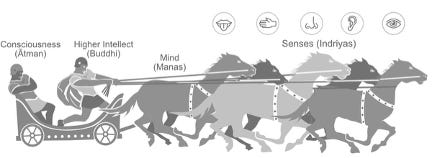
There is a crucial distinction here. In the Greek and Freudian models, reason occupies the highest position. In the Upanishadic model, reason is indispensable but subordinate. It is an instrument, not the inner self. Awareness is placed prior to thought, prior to judgement, prior to agency. This is not to argue that Hinduism has privileged access to the truth. The recurrence of the same intuition across cultures suggests the opposite: that the dilemma is universal. Different traditions give it different names, but they are gesturing toward the same recognition.
In the Katha Upanishad, the rider, pure awareness, is called the Atman. Christianity speaks of the soul. Sikhism speaks of the divine light (Jyot) within. Islam speaks of the Ruh, a spirit whose nature ultimately escapes definition. Jewish mysticism refers to Neshama, something breathed into human beings, not constructed by them. These traditions may profoundly disagree on theology and practice yet converge on a unitary truth. There is something within us that knows, and that knowing is not reducible to thought.
Psychiatry and psyche
Psychiatrists distinguish disorders of intellect, such as learning disabilities, from disorders of the mind, such as schizophrenia and bipolar disorder, in which intelligence usually remains intact. While exploring the inner state of a patient, psychiatrists conduct a “mental state examination” in which a patient’s speech, thoughts, feelings, perceptions, and cognitive functions (a term used for memory, intelligence, judgement, and abstraction) are assessed. All of these are collectively considered to be functions of the mind. A person can be intellectually normal but still experience terrible mental suffering. This division into learning disabilities and mental illnesses maps closely onto the ancient Indian distinction between manas (mind) and buddhi (intellect). The mind moves, reacts, associates, and fluctuates. Intellect discerns, evaluates, and judges.
Awareness is that within which both appear.
One need not hold any religious beliefs to verify this. Thoughts can be subjectively examined and objectively expressed in speech. Intellect can be tested, as we do all the time in school exams. Awareness cannot be objectified in the same manner. Awareness can only be experienced as subjective consciousness. It is not something that we possess. It is what we are aware with.
Seen in this light, the chariot metaphor is not about moral instruction or spiritual hierarchy. Instead, it describes the structural tension of being human: powerful instincts, a reasoning faculty tasked with navigation, and a conscious awareness that silently witnesses both.
Consciousness in physics
Many prominent physicists have argued that consciousness is fundamental to reality. The clearest statement about this came from Max Planck (1858-1947), one of the founders of quantum mechanics: “I regard consciousness as fundamental. I regard matter as derivative from consciousness.” Planck was not referring to consciousness in the sense of individual psychology. Instead, he considered consciousness as the ontological ground on which matter appears.
Erwin Schrödinger (1887-1961), another key figure in quantum mechanics said: “Consciousness cannot be accounted for in physical terms. For consciousness is absolutely fundamental.” Like Planck, Schrödinger was not talking about individual experiences but consciousness as a singular entity, an underlying fabric of the universe.
Eugene Wigner (1902-1995) formulated a thought experiment popularly known as “Wigner’s friend” in a 1961 article “Remarks on the Mind-Body Question”. He argued that nature is not fundamentally deterministic. It is not possible to formulate the laws of quantum mechanics in a fully consistent manner without reference to consciousness. For Wigner, measurement requires awareness, not just the interaction between an observer and the observed.
A common misunderstanding of these statements by quantum physicists is that consciousness creates reality. Reality instead is participatory and observer dependent, an idea articulated thus by John Archibald Wheeler: “No phenomenon is a real phenomenon until it is an observed phenomenon.”
Wolfgang Pauli (1900-1958) believed that there was a deeper psycho-physical unity, beyond merely the physical. During a period of personal crisis, he underwent psychoanalysis with Carl Jung (1875-1961). Their exchange resulted in a two-essay publication titled The Interpretation of Nature and the Psyche (1952). Pauli was not a mystical idealist. He believed that physics was incomplete without consciousness. He stated that an observer is not outside an experiment, but an essential way in which nature manifests itself. Jung did not believe that consciousness was a collective (in the social sense) but as trans-personal, even though experienced as localised in an individual. Together, they believed that our picture of reality was incomplete and that we had to consider the possibility of an underlying universal field. This is a remarkable anticipation of the current problem: can AI become conscious?
It is striking that when studying the nature of matter, quantum physicists, like Indian rishis, do not find more matter within, but something that is irreducibly further. One does not need religious dogma to reach the same conclusion through a deeper enquiry into one’s own inner self.
AI and Consciousness
Consciousness is neither a structure nor a function that can be isolated or tested. As technology progresses, AI may increasingly replicate intelligence, judgement, and even self-awareness in the narrow sense of being able to report its internal state. If a system can reliably report on its internal states, correct errors about itself, anticipate its own future behaviour, and revise its self-model, we may reasonably call it self-aware. Such a system may pass every behavioural test. Consciousness, as I am using the term here, refers to subjective presence; the fact that there is something it is like to be that system. This is not a behavioural property but an experiential one. It cannot be accessed from the outside because it is not an object among objects.
AI may build better chariots. But the rider - awareness- is not something that can be added. This is not a failure of technology, but, at least for me, a reminder of its limits. Some things can only be known by being.
Consciousness may be the one thing that can only be lived but never proven.
Thank you ever so much. I am glad it resonated. Be well.