

खंडर बता रहे हैं की इमारत बुलंद थी
Ruins announce that here once stood something mighty.
I cannot find a single, authoritative published source for this widely cited line, probably from an Urdu sheyr (couplet), but it is a well-known quotation. I first heard it when I was about 15 years old from an old man who was forlornly remembering his robust youth.
In this essay, I reflect on three kinds of perishing: that of individual lives, those that result from human violence, and the ones that are nature’s slow but inevitable erasure of everything. I wonder what, if anything, survives: stones, books, memories, or the meanings we lay over them.
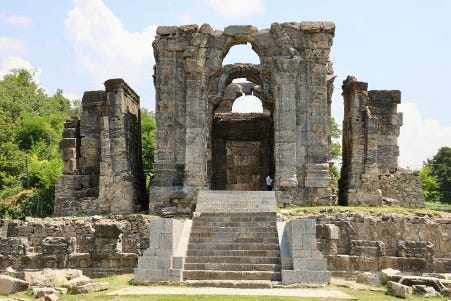
What does it mean to perish?
To perish is not just to die. It is to disappear slowly, to lose form, function, legibility, existence, and then to be lost to all memory. In the short story Metamorphosis, David Eagleman expresses this idea beautifully. There are three deaths. The first is when a person dies. The next death is when everyone who knows the person dies. The final death is when anyone who has ever heard of the person dies. That is the final erasure of the human being who once lived and loved.
Individuals die, cities perish, and mighty civilisations disappear.
There are two great philosophical questions that remain unanswered. Why is there something rather than nothing? Who created the universe? Both assume that something must exist. In Abrahamic religions, it is an external God; in Hinduism, it is Brahman (consciousness as the fundamental reality that created empirical reality). For Christians, the word was the beginning. In Hinduism and Sikhism, the beginning was Anhada Naad (unstruck sound).
Buddha said that there is no first cause, captured in the concept of anamatagga (without a first moment). He considered existence to have two basic attributes: annicca and paticca-samuppaada. Anicca means impermanence. Everything is in constant flux, arising, changing, and passing. Paticca-samuppaada is usually translated as dependent origination. It means that nothing exists independently. Everything arises from a prior condition. When a condition ceases, the object ceases to exist. The Buddhist formulation is: Imasmiṃ sati idaṃ hoti; Imasmiṃ asati idaṃ na hoti (When this is, that comes to be; When this is not, that does not come to be).
Stephen Hawking has asserted that “the laws of science seem to predict that the universe had a beginning”. Scientists now conceptualise a cosmos with a beginning and, therefore, at least in principle, a cosmos that could have an end, but the nature of its ending is uncertain. Some scenarios imagine continued expansion and a long “heat death”, while others entertain the possibility of a future re-collapse, a “big crunch”.
In Hinduism, existence is not an object but a rhythm described in three terms: leela, laya, and pralaya. Leela is the universe as divine play; consciousness (Brahman) revealing itself. Laya is when the individual form dissolves into this universal source. Pralaya is when the entire cosmic cycle dissolves back into the source, Brahman. As I have written before, the Creator in the Hindu view is the creation itself. It is a dance rather than a painting. Brahman’s leela starts the dance, laya is each step returning to stillness, and pralaya is the end of the performance. The curtain falls, and the stage goes dark.
I do not know which answer is correct. However, the Hindu view resonates with me. Some quantum physicists also consider consciousness to be the underlying reality from which existence emerges. But who knows?
Whatever the truth of the origin of the universe, perishing is not a local tragedy. It is written into the grain of reality itself.
Ephesus: a city that guided strangers by stone
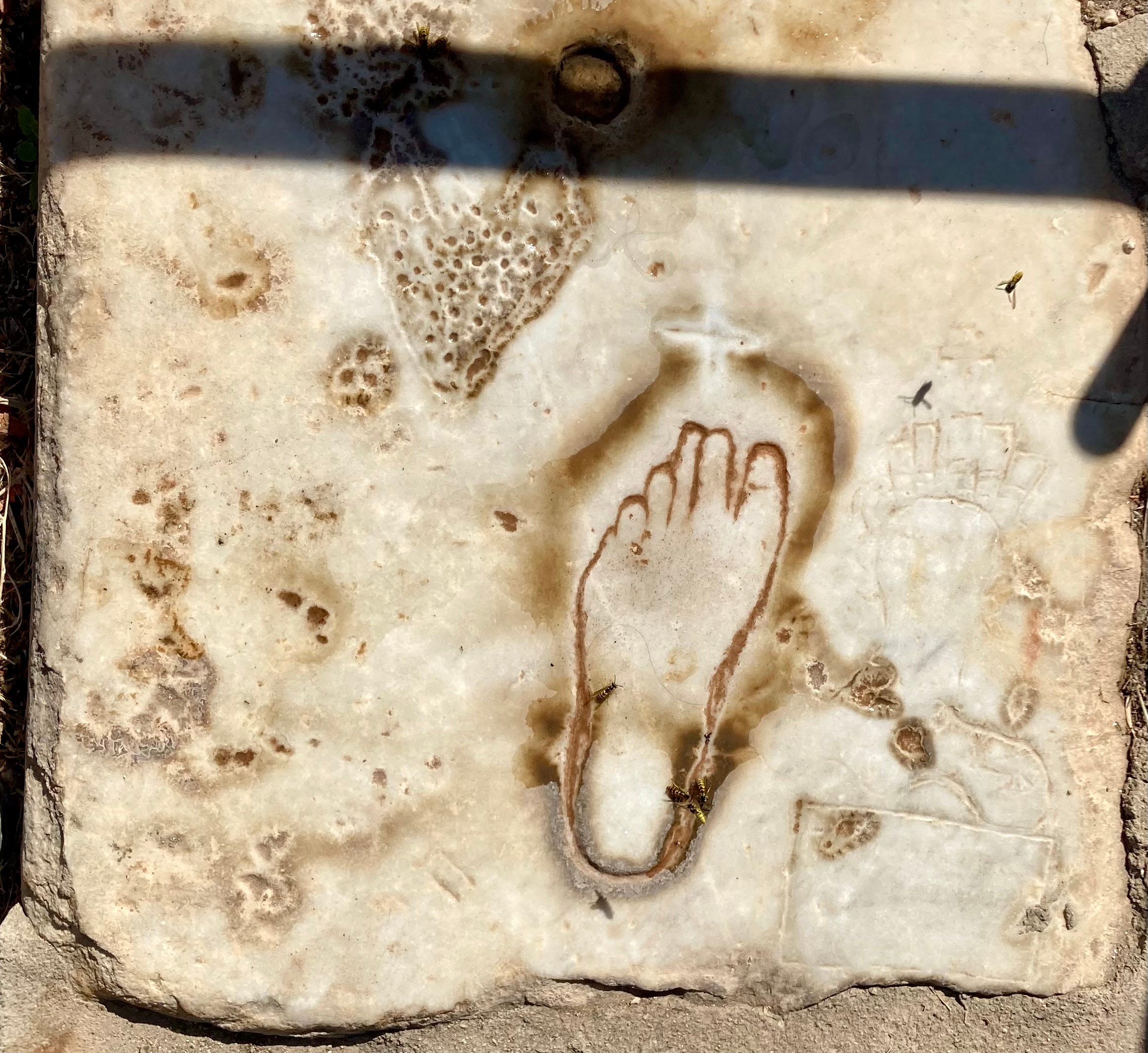
When I went to Ephesus, what struck me first was not only the grandeur but also the intelligence with which the city had been designed to meet human needs. There is a famous stone carving where sailors arriving at night could find directions by putting their feet into the carving. One toe points to a brothel, another to a place to eat or drink, and another to a place to rest. A sailor arriving for the first time in pitch darkness would not have to disturb anyone; his toes could lead him to whatever the city offered.
After navigating the city with your toes as a guide, you arrive at the Library of Celsus, an extraordinary structure. Its proportions, as guessed by the columns that remain standing, are astonishing. Only the dramatic facades have withstood the ravages of time. The library once housed an estimated 12000 scrolls, an enormous collection of human wisdom. Imagination struggles to recreate what the library might have been in its full splendour.
Ephesus collapsed into ruin for reasons that are, in the end, almost banal: geology and ecology doing what they do. The Cayster River silted up the harbour, and the city that lived by maritime trade found itself increasingly landlocked. The resulting marshy conditions contributed to diseases, including malaria, driving the decline and relocation of the population. Earthquakes and shifting political fortunes did the rest. Nature, in its usual indifference, allowed geological forces to take their course.
The Celsus library remains as a photo opportunity. I have lost all my photographs of Ephesus, including the negatives during various house moves. Another loss of the legibility of experience. Another reminder of impermanence and ways memories perish.
Nalanda: learning burned, and then silence
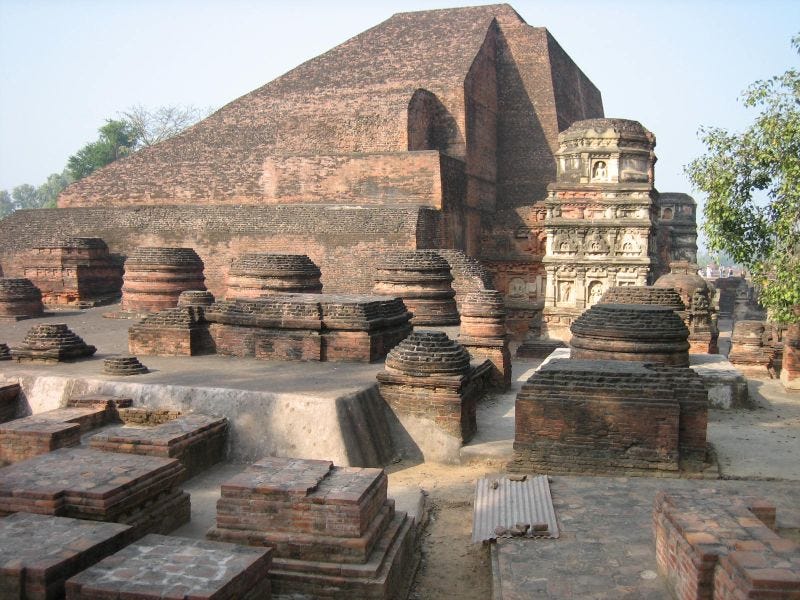
I have never been to Nalanda. In school history lessons, when I did not care about history, we were taught about Nalanda and Taxila, along with the Indus Valley civilisation. History was for other people. I did not have a long enough past to respect history.
Founded in the early centuries of the first millennium and flourishing for hundreds of years, Nalanda was one of the world’s great residential centres of scholarship: a vast monastic-university complex drawing students from across Asia. UNESCO’s description of the archaeological site captures what the ruins reveal: this was not a single building, but an entire ecosystem of monasteries, temples, classrooms, and courtyards; an entire architecture devoted to learning. Chinese travellers came to study, and their records confirm the importance of Nalanda as the world’s first, most renowned, and largest residential university.
Then came fire and conquest. In the late 12th Century Muhammad Bakhtiyar Khilji conducted raids across monasteries in Bihar, including Nalanda, Vikramshila, and Odantapuri. Monks were tortured and killed, libraries were burned, and monastic complexes were destroyed. If you Google Nalanda, you will find varying accounts of why Khilji destroyed Nalanda, depending on the tribal loyalties of the narrator. Regardless of Khilji’s intentions, the fact that he initiated the destruction of Nalanda is not in doubt.
Libraries as monuments to wisdom
Ephesus and Nalanda are monuments to the idea that knowledge is a form of immortality. That if we collect, teach, copy, and preserve, we can outlast our own brief lifetimes.
And yet both vanished.
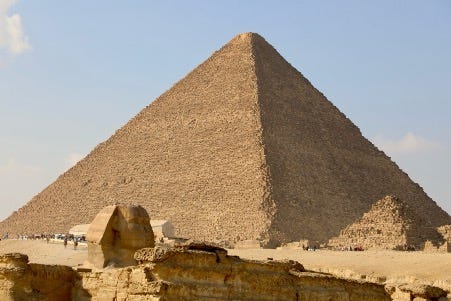
One by natural forces and the other by human wickedness. In the final accounting, the mechanism is irrelevant. Everything perishes. Even the pyramids, those seemingly defiant geometries, are slowly being eroded by wind, sand, pollution, time, and tourism. When I first saw the Pyramids in early 1990, you had to travel some distance from Cairo to see them in the desert emptiness. You can now have a McDonald’s or KFC within a short distance of the Great Pyramid of Khufu (Cheops).
To understand impermanence is not to despair. It is to see clearly what permanence has always been: a story we tell ourselves because we are temporary creatures who long for immortality. Libraries, museums, sarcophagi, names of lovers carved on a tree trunk, palaces, paintings, statues, and writing this blog are all desperate defences against death and perishing.
Even the Himalayas are temporary
I am from Kashmir. I am drawn to mountains. There is a deep calling which must be evolutionary. My ancestors originated from the mountains. I feel genetically programmed to love mountains. As a medical student in Jammu, I travelled regularly across the mountains of Kashmir and Himachal Pradesh, as often as my meagre resources permitted. In 1980 I hitchhiked to Ladakh to visit the Hemis Monastery, and then walked from Leh to Kargil without any trekking equipment and without knowing the local language for over three weeks (134 miles, 215 km). I stayed overnight with villagers who provided unwavering hospitality, without expecting anything in return.
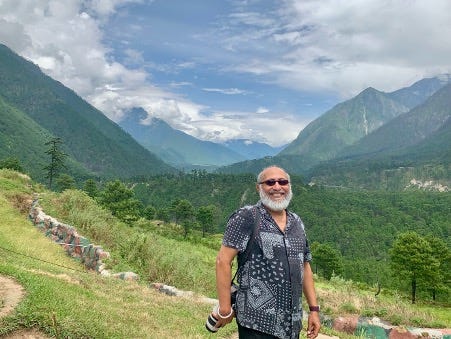
Before that in 1978, I had spent two weeks in Dharmsala, where I met the Dalai Lama. He gave me a piece of slate with carvings. Everyone had brought an offering as he walked through the crowd, giving his blessings. I apologised for not bringing an offering and explained that I was a medical student visiting McLeod Ganj for the first time. He beamed and gave me a slate carved into which was carved Om Mani Padme Hum (Hail to the Jewel in the Lotus). It is the only thing I have carried from my past. He was not a celebrity at the time. Hollywood had not discovered him. I, a callow youth, was not mature enough to ask him the questions that I would now ask him. Even then though, I sensed that I was in the presence of an advanced soul.
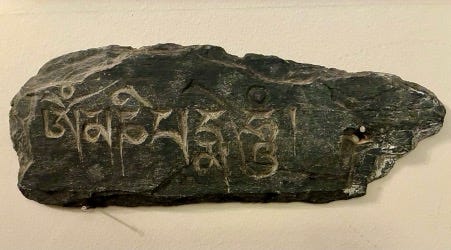
I had no camera then. I have no picture of a youthful me standing next to a beaming Dalai Lama. But does it matter? It was a moment in time. Impermanent. It happened to me. It lives in my memory. It will perish with me. So will this slate, although it is likely to outlast both the Dalai Lama and me.
The mighty Himalayas will not last forever. These mountains rose from the collision of tectonic plates, with the Indian Plate pushing into the Eurasian Plate beginning roughly 50 million years ago, a collision that continues to shape the range today. They are being eroded relentlessly. I last returned to Kashmir in 2023. My clan’s houses in Srinagar are occupied by others; all my relatives were forcibly driven out at gunpoint. The rivers, forests, and glaciers I knew in Gulmarg, Pahalgam, Sonmarg, and Anantnag have all but disappeared. Mountains have been denuded by rapacious timber merchants. The Sufi Islam that coexisted peacefully with Kashmiri Vaishnavism has been replaced by brutal totalitarianism. The Kashmir of my memory has vanished.
The grand unmaking
Is perishing personal or cosmic? I have written elsewhere about the tragedy of Kashmir? Why should I mourn my clan’s cleansing from their land? The cosmos is full of unmaking. The Moon is drifting away from Earth at approximately 3.8 centimetres per year, roughly 3.8 meters per century. The Sun will not burn forever. NASA has noted that the Sun will become a red giant in approximately 5 billion years.
What do these numbers even mean? Not just mathematically, but to me, perceptually? I can only imagine my existence two generations on either side. My clan was driven out of Kashmir in the early 1990s. It hurts us. It will mean nothing to my great-grandchildren.
My life is finite, as is my capacity for love. I can only extend it to my imagined grandchildren, who are not yet born but already loved. Beyond that, who knows? I try to detach myself from present suffering by meditating and immersing myself in spirituality. My personal griefs and anguishes seems both intensely immediate and insignificantly small in the grand cycle of creation and destruction that operates in the universe.
The cosmos ceases on vast timescales. Galaxies merge, stars collapse, civilisations perish, cities get wiped out and all personal memories disappear when a being dies. Everything will eventually cease to exist. If you compare the enormity of the universe with the infinitesimally small scale of human life, it does something odd to your heart. Time widens until personal pain feels both intimate and small.
A ruined mansion near home
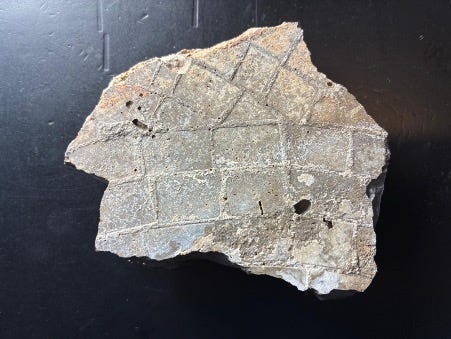
Not far from our house, there are ruins of an old mansion: just a few bricks and a fragment of a tiled mosaic that somehow survived the vandalism of weather and neglect.
I stand there and wonder about the lives lived inside. Love-making and child-rearing, fighting and forgiving, the small rituals of food and fatigue, the long arguments that end with doors being slammed or laughter, the private heroism of caring for someone sick, the soft cruelty of impatience, the ordinary miracle of waking up and trying again.
All of it is now compressed into a rectangle of broken tiles.
Should we grieve perishing?
Why shouldn’t we grieve? Grief is love that encounters the finitude of our existence. How can we not grieve our own perishing and that of those we love?
But I am beginning to wonder whether grief is the only possible response to impermanence. There is another way of dealing with the reality of impermanence: awe, reverence, and gratitude for here and now. If everything perishes, including us and those we love, then perhaps the right response is astonishment at not that things end, but that anything exists at all; that there is something rather than nothing, and that we, improbably, participate in it.
The immensity of the cosmos could make us feel insignificant. Or the fact that we now know so much about it can make us proud. I feel a mixture of awe at the world, pride at humanity’s achievements, and personal gratitude that I have been allowed to take part in this strange, brief, luminous experience of being alive.
My children live through me. Their existence is also impermanent. But they are likely to have children, who will have children. Perhaps knowing that is enough. To have lived and loved, to remain in a few people’s memory after my own perishing, and to hope that the gift of memory and recall will keep me alive for little longer than I breathe, two generations on either side, is enough.
खंडर बता रहे हैं की इमारत बुलंद थी
Ruins announce that here once stood something mighty.
Ruins celebrate existence. We cannot defeat perishing. We can only but try to remain legible to one another while we still can.
A thoughtful meditation on how much we try to preserve and how little we can keep
Another deeply moving piece. Thank you Swaran. I am reminded of a time, still consumed by anxiety and training to teach mindfulness, when a wise teacher informed me that I am 'an insignificant dot in the universe.' A 360 degree swerve in perspective, enabled by a few words spoken with a compassionate smile. The anxiety fell away in that moment. The weight of responsibility with it. A return to being, free of grasping or clinging, as the essay also points to.