


Beyond what is visible. Photograph by the author
“Gaps, by default in the mind of the creationist, are filled by God”. Richard Dawkins, The God Delusion (2006, p. 154).
“Charles A. Coulson … damned it with the telling phrase ‘the God of the gaps.’…. it was a foolish move and was increasingly abandoned in the twentieth century”. Alister McGrath & Joanna McGrath, The Dawkins Delusion?(London: SPCK, 2007, p. 29).
Science, Spirituality, and the Stories We Tell About Reality
Richard Dawkins has argued that the idea of God is used by creationists to fill in gaps in our scientific knowledge – hence the God of the Gaps. The McGraths assert that God is not evoked by theists to explain what science cannot currently explain, but as the explanation for why anything exists at all. Both Dawkins and McGrath are rejecting the same intellectual move: using God as a placeholder for ignorance. Where they differ is not so much what they reject, but what they think follows once it is rejected.
In this blog I will try to capture this tension by deliberately polarising the discussion as one between Nothing-Butteryand What-About-tery.
A major problem with the debate is that both sides argue predominantly or exclusively within Christian theology and the wider Abrahamic traditions. Christopher Hitchens’ God Is Not Great could be framed as a direct rebuke not only to Christianity but also to Islam, implicitly echoing Allahu Akbar as a claim about divine greatness competing with secular reason.
The Abrahamic View
Abrahamic religions are followed by almost half of the world’s population (3.8 billion as per Wikipedia’s Major Religious Groups”). That still leaves around half of the world’s population whose views and perspectives are simply not included in the discussion above. This necessarily reduces the argument to a narrow conception of God.
Given that all believers of Abrahamic religions stress that their group alone has the handle on the truth, that their God is the only true god, and their book is the only or last revealed word of God, no wonder that there has been plenty of bloodshed in European and Middle Eastern history between adherents of these religions. If you are the chosen people, the other group is non-chosen and hence excluded. You can justify your actions by treating the excluded ones like ignorant children who need educating or recalcitrant ones who need punishing if they do not mend their ways.
There is an unspoken assumption that this is the only conception of God worth arguing about. As if metaphysical reflections, philosophies, and belief systems elsewhere do not count. As if, to paraphrase Macaulay, a single shelf of a European library still outweighs the rest of the world.
Spirit, rather than God
I am not here to defend or attack the Abrahamic God. I am concerned with something more elusive which I will call Spirit, an animating principle that suffuses the universe and whose existence does not require a special deity, a prophet, a messenger or a son, or a special scripture. I am simply inviting readers to pause, reflect, wonder and marvel at the mysteries of existence without dogma, superstition, arrogance or certainty. There are no conclusions to be drawn here nor definitive answers provided. My aim is to simply invite readers to shift perspective if they are willing, shed dogma if they are able, and remove fundamentalism in discussions about science and spirituality.
Learning humility from Jainism
The Indian religion Jainism has a core principle called anekāntavāda, literally ‘the variousness of reality’. Jains are required by their religion to accept that since reality is complex and multifaceted, and no single viewpoint can capture the whole truth. All perspectives may be partly true, and hence a combination of nayavādas (individual perspectives) is likely to be closer to the truth.
Adherents of Jainism are required by their religion therefore to avoid dogmatism, be open-minded, avoid conflicts and promote harmony. Interestingly, Jainism explicitly denies the existence of a creator God.
Clarifying definitions
Nothing-Buttery can be defined as the mindset that explains reality by collapsing it into its smallest measurable components. All of reality is nothing but matter, chemicals, laws of physics and probability. It is all chance; there is no intrinsic purpose.
Nothing-Buttery often presents itself as rigorous, hard-nosed, and intellectually honest. In practice, it tends toward absolute physicalism and hard determinism masquerading as clarity. It assumes that questions of metaphysics, values, and qualia are either meaningless or irrelevant. It also represents its critics, sometimes subtly and often crudely, as either people who are not clever enough to understand science or are too dogmatic to try. All questions of meaning are considered empirically non-falsifiable, hence unscientific, and therefore not worth asking.
I am aware that critics might accuse me of doing exactly what I am arguing against: reducing the other person’s argument to a caricature. I therefore will clarify here the difference between methodological naturalism from ontological naturalism.
Methodological naturalism is a scientific principle that science should only look for natural causes without the need for God or Spirit or non-material explanations. This is the method by which science seeks explanations for reality. How to do science. Ontological naturalism is a philosophical idea about what exists. It claims that only natural things exist, there is no supernatural realm. It is a world view. Atheist scientist often slip in the latter to bolster the former, but these are distinct ideas, not equivalent or mutually transferable.
One can be a methodological naturalist i.e. do science as a method, without being an ontological naturalist. Blaise Pascal, like Isaac Newton, was a mathematician and a physicist, but deeply spiritual (see my blog).
What-About-ery is what Dawkins describes as the ‘God of the Gaps’. Instead of engaging with the scientific discipline, including burden of proof, cautious scepticism, peer review and rigorous methodological discipline, in discussions about God it points elsewhere. In its evasive form, it says, “Aha, but sceince can’t explain X, therefore God exists”. In its integrative form it says, “what about meaning, experience, qualia and consciousness?”
A scientist could legitimately argue that the burden of proof lies on those who assert the existence of God, rather than the other side having to disprove it.
Non-overlapping Magisteria?
This tension between these two positions was famously articulated by Stephen Jay Gould in his idea of non-Overlapping Magisteria. In his words, “science gets the empirical realm: what the Universe is made of (fact) and why it works this way (theory). Religion extends over questions of ultimate meaning and moral values. These two magisteria do not overlap, nor do they encompass all inquiry (consider, for starters, the magisterium of art and the meaning of beauty)”. In this perspective, science addresses facts and mechanisms, religion addresses meaning and values.

Irreducible beauty. Photograph by the author
Perhaps the two magisteria really do not overlap. Or perhaps we lack the language to describe the overlap. Might the overlap be beyond language and in the realm of subjective experience that cannot be articulated? The Tao that cannot be described?
Science Without Reductionism
In my earlier piece Here Be Dragons I argued that neuroscience cannot map every terrain of the psyche, and that maps should not be confused with territories.
Imagine a thought experiment. Suppose we could map the brain in extraordinary detail. Every firing neuron, every synaptic chemical exchange, every feedback loop and forward firing pattern could be described in detail, along with the underlying biology, physics and chemistry. Now imagine an individual, wired up to this intricate apparatus to objectively measure all their mental activity. The individual is shown a picture of someone they love: a partner, a child, a pet. The apparatus tells us everything about activation patterns in specific parts of the brain, neurochemical changes down to the molecular level, and autonomic responses from heart rate to ion exchanges between membranes.
Nowhere in this vast collection of data and observations do we find love itself. Even if we catalogue every physiological accompaniment of love, love itself remains absent from anatomy and physiology.
We can repeat this in a comedy club with the audience all wired up to the apparatus. When they laugh at a joke, nowhere will we find humour as a physical entity.
We find correlates of mental states, never the experience.
I understand grief and loss when I talk to my patients. I do not need to see their brain scans. So where are grief, love and humour to be found?
This does not diminish neuroscience. On the contrary, it honours its achievements while recognising an epistemic limit.
Lived experience is, by definition, lived from within. It does not fully lend itself to external objectification.
Spirituality Without Escapism
Spirituality, like love or humour or grief, is experiential. There are serious scientific attempts to study mystical and transcendental states without mystification. I had the privilege of having a paper on a personal inexplicable ‘mystical’ experience accepted in a scientific journal. I did it trepidatiously, expecting to be mocked, but was heartened by the response. It resonated with many people. Several studies now show how meditation and other contemplative practices are associated with brain changes, regardless of the religious belief of the practitioner.
And yet, subjective experience alone is not truth. As a psychiatrist I know this every time I meet someone suffering from a psychotic illness. Psychosis is, by definition an altered experience of reality. A person with psychosis genuinely hears voices in the absence of an external stimulus and sincerely believes their delusions. All subjective alterations of reality are not revelations.
RD Laing and other anti-psychiatrists once suggested schizophrenia might represent an enhanced or evolved state of consciousness. Those who live with schizophrenia, care for someone with it, or treat it know how devastating that idea is. The illness can strip individuals of dignity, agency, and humanity. Subjective claims, therefore, cannot be taken at face value, whether mystical or pathological.
Touching a numinous moon
Last year, at the Kennedy Space Centre in Florida, I touched a piece of moon rock that is on display. You can stick your finger through a plastic screen and rest your finger directly on the surface of the moon. It was low season, and there was no one behind me in a queue. I stood there transfixed. I felt something through my fingers, a sense of awe, mysterious and celestial. I did not suddenly start hearing the moon speak to me, nor did a moon god or goddess enter my soul. It was something preverbal, ancient and primeval.
Last night I saw a near full moon glow over the freshly fallen snow. I suddenly thought, I have touched you. The same primitive and ancient awe arose in me. Again, I was transfixed. I could sense something emanating from the moon that I received. The closest I can come to describe it is numinosity: a deep and profound evocation of something mysterious, ancient, deeper than words, prior to being, almost holy, not needing a religious belief.
‘Just a bit of temporal lobe malfunction’
Medical literature is rich with studies of patients with temporal lobe epilepsy or damage to the temporal lobe who report mystical visions, sense of awe, and auras of blissful certainty. Temporal lobe is part of the brain connected to the limbic system which is crucial for emotions and memory. Some have even suggested the presence of a “God Centre” in the temporal lobe which specifically evokes religious experiences or sense of the divine. Others have argued that such a neural system has evolved to promote communal religious feelings, altruism and social bonding.
The Radio Analogy: Function is not Origin
Someone unfamiliar with how a radio produces sound may reasonably assume that sound is a function of the radio itself, and that when the sound ceases the radio has malfunctioned. The inference is understandable but incomplete. A radio does not generate music; it receives, tunes, and transduces signals that already exist as electromagnetic frequencies. One may dismantle the radio entirely, trace every circuit and analyse every component, and still never discover the broadcast itself. Studying the radio explains how sound is modulated, not where it originates. The critical error is to confuse dependence with origin. Damage to the antenna, breakdown of a circuit, or loss of power all disrupts access to the signal, but do not imply the signal itself has ceased to exist.
This analogy does not prove the brain receives consciousness; it only shows that correlation does not logically entail production. Experience may not be entirely collapsible into its biological substrate.
Language as the Hidden Battlefield
The deepest conflict between science and spirituality is not empirical, it is linguistic. Debates are framed as binaries: true/false; real/unreal; scientific/pseudoscience. Absolutist language that is ironically frowned upon in science re-emerges in scientific dogmatism. Words like just, only, nothing but do immense hidden work. Often the terms of debate are never agreed upon in advance. Strawmen are fought, victories declared, and the deeper question remains untouched.
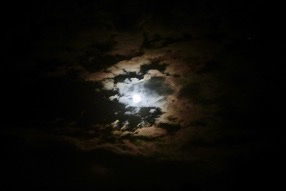
The numinous, partly revealed. Photograph by the author.
The Tao Way
A Zen koan reminds us: “What is the sound of one hand clapping?” The point is not the answer. It is the collapse of the question itself. Guru Nanak, the founder of Sikhism wrote that the divine (spirit) cannot be captured in words. And as the Tao Te Ching famously opens “The Tao that can be spoken is not the true Tao.”
Language fails, not because reality is irrational, but because reality is richer than our categories.
What one feels when gazing into the eyes of one’s dog, or watching a sunset, requires no dogma, be it scientific or spiritual.
Some, as I do, will marvel and speak of spirit. Others will explain it as blind forces of evolution producing awe as a survival mechanism.
To each their explanation. Just as to each their experience.
Both sides need to respect doubt and shed dogmatic certainty. The Hymn of Creation in the Hindu Scripture Rig Veda(10:129) captures this uncertainty beautifully.
Whence all creation had its origin,
the creator, whether he fashioned it or whether he did not,
the creator, who surveys it all from highest heaven,
he knows - or maybe even he does not know.
Perhaps we could all do with a dose of Jain anekāntavāda, an acceptance of ‘the variousness of reality’. Perhaps the universe is suffused with spirit. Or perhaps spirit is the name we give to what refuses categorisation.

Explained, yet full of mystery. Photograph by the author
I largely align with your framing, though I find myself pausing at the final step of affirming science and spirituality while setting religion aside.
For me, part of the hesitation comes from the domains being compared. Mathematics, though not empirical, seems to touch questions that science never fully reaches, yet even there Gödel reminds us of inherent limits. That doesn’t automatically favor religion, but it makes me cautious about assuming science is the right lens for questions that go beyond its scope.
I’m also unsure about the role of spirituality here. Retaining it while rejecting religion seems to preserve certain metaphysical intuitions without clarifying what grounds them. For me, this can feel more like personal preference or comfort than serious engagement with ultimate questions.
Ultimately, I see the issue less as science versus religion and more as what kind of truth I or anyone is seeking. One can commit to empiricism, embrace subjective spirituality, or pursue religion as an inquiry into eternity. What seems like a middle ground to me often reads as the familiar agnosticism of science, presented as intellectually neutral while implicitly dismissing what it labels as ignorance or superstition.
Very well written Swaran! We all can do with a dose of Jainism tolerance!