

“Not only was I exiled, paralyzed, mute, half deaf, deprived of all pleasures, and reduced to the existence of a jellyfish, but I was also horrible to behold.” (Jean-Dominique Bauby, The Diving Bell and the Butterfly)
Gravity’s calling

A tilted lotus. Photograph by the author
I had been sitting in the lotus position for about 45 minutes, doing a chakra meditation. My right ankle is damaged, so I make a slightly bent and tilted lotus, as if only one side of it has been fed. As I tried to get up, realising my left leg had gone numb, I took support from a sofa armrest.
I collapsed. My leg was not just numb; it was momentarily paralysed. The crashing sound woke my wife and she rushed down. I felt shame at how I imagined I looked to her. A heap of an old man, not the strong muscular man she had married.
We live under the illusion of weightlessness. Gravity is invisible, even as it holds the universe and all within it in place. We move through the world supported by unknown working of our musculature. But as I rose from the stillness of the lotus, that illusion shattered.
The pins and needles were expected. But the complete motor silence felt a betrayal. As I tried to stand up, my leg seemed absent from where it should have been, missing without permission, revealing not the absence of my will but my leg’s refusal to obey it - the full force of gravity disclosed. The earth had claimed my mass, and I could not deny its claim. It was a frightening reminder that I am a physical object first, a conscious being second.
From Thought to Gesture
We take our control over our muscles as a given, only to realise it when it is taken away. And we rarely pay attention to the sheer ‘amazingness’ of what is involved in even the most trivial of movements
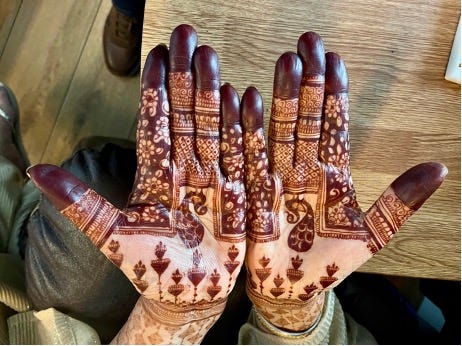
A human hand has 34 muscles. Photograph by the author
Consider the staggering complexity involved in pointing a finger towards an object.
An intangible volition arises in the motor cortex of the brain. A remarkable series of experiments by Benjamin Libet in the 1980s showed that the brain prepares for an action a few hundred milliseconds before a person is consciously aware of an intention to move. Who within you decided to move before you are consciously aware is a matter of intense debate between neuroscientists and philosophers and I will skip it here, since it requires its own exploration in a separate blog.
Once you/the brain has decided to take an action (point a finger in this instance) an electric signal is initiated in a brain cell, a neurone. Each neurone is a miracle of anatomy and physiology. It has one axon, a wire-like structure that carries messages from it to other neurones, and a forest of dendrites, shorter wires that carry messages to it from other neurones. When you decide to move a finger, an action potential is generated in a neurone. An action potential is the neurone firing off a signal. When the signal reaches the end of the line, it hits a synaptic cleft which is a microscopic (20-50 nm) space between the nerve and the muscle. Here, electricity ends and chemistry begins. Tiny vesicles filled with fluids (neurotransmitters) flood the space with this fluid, which then locks on to receptors on the muscle cell membrane. Neurotransmitters and their receptors are precise and unique combination of locks and keys. The receptors activate a cascade of activity which leads to muscle fibres pulling and pushing - outgoing signals from the brain tell the muscles to act, inbound sensations feedback signals to the brain, and specialised receptors, proprioceptors, tell the brain exactly where your finger and all the muscles involved in the action are located. Biological gates open and close, electric impulses rush to and fro. Position, movement, force, coordination and balance all occur outside of your awareness; a magical dance of physics, chemistry, biology and whatever it is that constitutes our life force.
The Molecular Fuel: ATP
Zoom into an individual synapse and deeper mysteries unfold. All our cells contain mitochondria. Mitochondria are miniature entities that seem to have a life of their own; they certainly have their own DNA which we inherit almost entirely from our mothers. Mitochondria change very little across generations, hence their study has been crucial in scientific discoveries related to human migration. Mitochondrial DNA has contributed to evidence for an “Out of Africa” origin for modern humans, and to the idea that all living humans share a common direct maternal ancestor, sometimes called “Mitochondrial Eve”.

A burst of energy. Photograph by the author
Inside the mitochondria is a special chemical called ATP (Adenosine Triphosphate). ATP is the fuel that drives muscle activity. Think of it as a rechargeable battery. Mitochondria use the food we consume (breakdown of sugars and fats) and convert these into ATP. To move that finger, trillions of ATP molecules must simultaneously “snap”, releasing a tiny, violent burst of energy by shedding a phosphate group. This chemical energy is what allows the proteins in your muscles (actin and myosin) to crawl over one another, shortening the muscle and defying gravity. At any given second, sextillions of these molecular events are happening in perfect, rhythmic synchronization. It is a material process of pumps, gradients, and explosions, yet the sheer scale of the coordination is enough to evoke a sense of holy awe.
The Quantum Ghost: A Dance of Emptiness
If we zoom in further past the molecules to the atoms, and past the atoms to the subatomic realm, our “normal” sense of the world fails us entirely.
We feel solid, but scientists tell us that an atom is 99.9999% empty space. If the nucleus were a marble in the centre of a stadium, the electrons would be like dust motes floating about. Zoom in further and you meet no objects, just quarks, spin, probabilities and collapse of the wave function, concepts so abstract that they defy language. Particles act as waves, may exist in multiple states at once (“superposition”), and can get “entangled” so that changing one will change another instantaneously, even if they are millions of miles apart. Particles exist as probabilities, and collapse into an actuality only when observed. What we perceive as “solid” leg or “hard” floor is merely the electromagnetic repulsion between these clouds of probability. The pain from my twisted ankle did not seem to me to arise from my observation; I was forced into observing it by its intensity and severity. But then the subatomic world’s dance is too far removed from my limited understanding of reality and its perception of reality through my crude five senses.
Yet this is all happening. All the time. All around and within me. Including when I collapse under the irresistible force of gravity
The Mundane and the Miraculous
I fell. It hurt. I started thinking about the process involved. The more I thought, the less I understood. I could only wonder. Is everything just a blind roll of the cosmic dice? Or might there be an internal logic to the unfolding of the universe towards a goal? Is a painful effort worth the additional headache of trying to work this out?
Our bodies are so effortlessly and unknowingly miraculous that we are blind to their mysteries. In the mundane act of standing up, feeling pins and needles, falling down and standing up again, something amazing is going on at whichever level I choose to observe it-from the sensation of pain, the love of my wife, the wiring my bodily organs to inner machinery of my cells right down to the spinning quarks.
Living a life full of awe and wonder may not require witnessing amazing and unusual things and events. Falling down and standing up are also miracles. Once you pay attention to even the trivial, you find that nothing is trivial.
A joy to read such eloquent prose. This piece left me wanting to read more on the level of physiology meeting quantum physics. For example, the remarkable and yet limited view of our experience thanks to our eyes. The inaccuracy of perceived solidity and within a relatively narrow colour spectrum. Towards the end of the piece, I was reminded of the admirable process of a baby learning to walk.
Thank you Swaran.