

“वहाँ कौन है तेरा, मुसाफ़िर जाएगा कहाँ”
“Who waits for you out there, O traveller, where will your wandering lead”
“दम ले ले घड़ी भर, ये छैंयाँ पाएगा कहाँ”
“Breathe some restful moments here, where else will you find such shade”
Opening lines of the song “Wahan Kaun hai Teraa” from the 1965 film Guide, based on a novel by R.K. Narayan. Lyrics by Shailendra, music by S.D. Burman. A YouTube video link with English translation is provided at the end of the article.
All photographs by the author
Every time I feel myself pulled toward the allure of ‘there’, this song calls me back. I am not arguing against ambition or self-improvement. I am only noticing that the peace we chase in the future often sits beside us here and now, revealed not by reaching the next milestone but by pausing after a long and restless search.
The Indian write R. K. Narayan (1906-2001) is best known in the West for his stories set in the fictional South Indian town of Malgudi. His writing style, a detailed and exquisite analysis of everyday life, observed with compassion and gentle humour, and captured in compressed prose, has been compared to Faulkner, Chekhov, Gogol and Guy de Maupassant. His novel, The Guide, published in 1958, is also set in Malgudi and was made into a wonderful film, considered one of the greats of Bollywood cinema. It is a story of a flawed man’s egoic ascent, decline, shattering, and possibility of redemption. ‘Possibility’, because the ending is deliberately ambiguous.
The Guide
The protagonist, Raju, is a street-smart tourist guide who uses his charisma, energy, and exuberance to get along in a world that does not fully satisfy. He guides people but does not know where he wants to go. He falls in love with Rosie, a dancer in a stifling marriage with a dour and unsupportive husband, from whom she eventually splits. Raju encourages Rosie to follow her passion for dancing and becomes her manager, guiding her to stardom. Their relationship collapses under the weight of ego, suspicion, the corrosive impact of fame, and Raju’s forgery of Rosie’s jewels. He is sentenced to two years imprisonment and the couple split.
Emerging from jail as a diminished man, he wanders into a drought-stricken village, where he is mistaken for a holy man capable of miracles. This is where the song finds him (and us).

After initially resisting the role of a holy man, Raju finds purpose in guiding innocent and desperate villagers out of their drought-stricken misery. Under pressure of the villagers’ belief in his divine powers, Raju undertakes a ritual fast for rain. In the film’s haunting final movement, an emaciated Raju walks into the river as thunder rumbles in the distance. It is unclear whether Raju drowns or whether it rains. The story now becomes a parable of transformation, where a flawed man’s accidental sainthood reveals an ambiguous boundary between deception and redemption.
The seductive call of ‘there’
The song’s opening line poses a profound question. We spend our lives searching for ‘there’. Out there is our perfect lover, a successful career, a fulfilling life and a legacy. The song asks us, Where is that place? Who is there for you? What are you running from? Who are you running to? Is resting in the shade here now not preferable to the imagined perfection of the future?
Raju becomes a ‘saint’ not through study, intent, or awakening, but through sheer physical, mental, and egoic exhaustion. The song reminds him that existence is ephemeral, like water waves. Existence is as transient as writing on water waves. We do not have a permanent home or residence. In this life, we are tourists seeking a destination and a guide to help us get there. However, the guide lies within. We only find it when we stop searching for it.
Rain basera (literally a rain shelter)
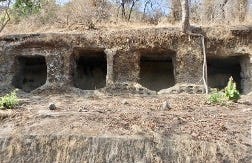
Life, in an old Indian metaphor, is a rain basera, a shelter you slip beneath while the storm passes by. Nothing is meant to be kept; it is only meant to be witnessed. The roof leaks a little, the wind hums through the bamboo, and it still offers a moment of peace. In this view, the wandering mind that chases distant horizons forgets the quiet gift of the present moment. Resting in this temporary refuge, here and now, is an act of wisdom. The world keeps moving, but you do not have to chase every cloud. Sometimes, the truest path is simply to sit, breathe, and let the rain fall where it will.
The song concludes with a metaphor of the hans (swan). In Indian mythic symbolism, swans represent noble souls. Swans have unique properties. They subsist on pearls. Given milk mixed with water, a swan can drink only milk and leave the water; that is, it can discern the eternal from the ephemeral. Eventually, like a swan, we must all fly alone. There is no ‘there’ to reach. The destination is an internal journey in which the “I” disappears.
Raju finds peace when he is no longer a guide, lover, prisoner, or saint. He is simply a witness (Sakshi).

Lessons for contemporary life
In our hyper-connected age, with its superabundance of possibilities to fulfil all our cravings, we believe that the next destination, whether in love, career, profit, advancement, or success, is just a bit further away. There, we will finally rest. The song reminds us that we can rest in now. Our bodies will decay. Our possessions perish or pass on to others. The house we call home will be inhabited by others. There is no peace out there. Rest in the now.

It has taken me a lifetime to discover that there is no perfect destination hidden beyond the horizon of the future. There is only this brief shelter, this breath, and this stillness.
Youtube link to the song here
Thank you Raneesh. I thought it might resonate with you. Read the others as well. I am giving a lecture in Chennai on 13 March. Will be great to see the two of you there.
Lovely read and thought provoking. The present moment as it unravels increasingly seems to be my point of focus. Staying as an observer serves well. Blessings.