

“To see a World in a Grain of Sand
And a Heaven in a Wild Flower” Auguries of Innocence by William Blake
While cleaning my back garden for new planting, I found remnants of beans I had planted last year but had never fully cleared away. One pod had survived the severe winter. It was shrivelled and seemingly lifeless. Yet when I cracked it open, inside were five seeds. I have kept them for planting this year.
Beans flourish under my care in a way that other vegetables do not. With tomatoes, I sometimes succeed; with potatoes, more often; but beans and I have an understanding. Brassica flourishes as well, but the cabbage leaf butterfly and its writhing green caterpillars defeat me each year with their sheer numbers and insatiable appetites.
The five seeds sit in a jar along with bulbs I plan to plant this year. I am waiting for the ground to thaw, for warmth to return, so I can clear the soil in which I will plant them.
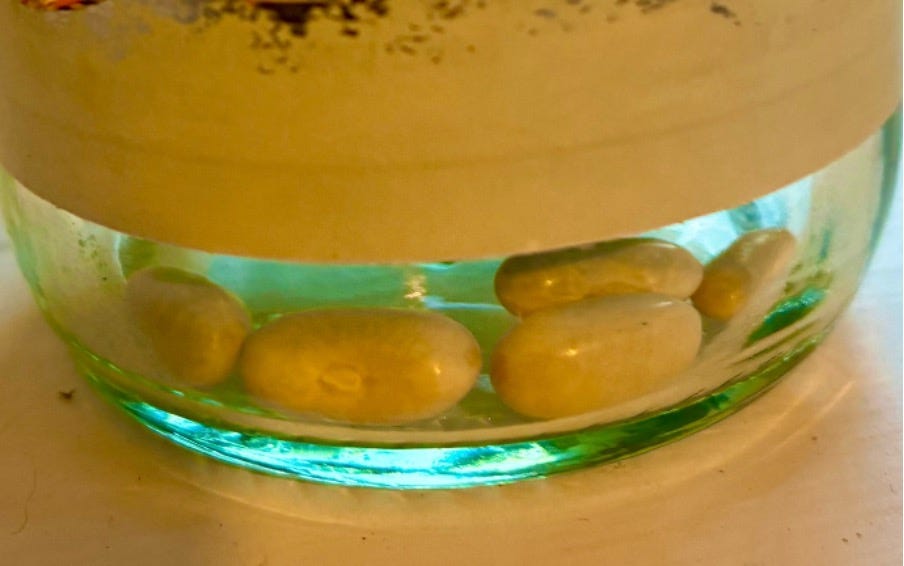
Every time I see the jar, I wonder what is alive inside that bean. Something is, for sure. But what? Is the living happening or is living a possibility awaiting the right conditions to emerge? If it is a mere possibility, how can it be called alive in any sense? I can boil and eat them as well. I can make a veggie burger with them. Or I could fill the jar with water, and magically, life will appear as a sprout.
Where was that life hiding? And is that hidden entity a living thing or the promise of one? What does it even mean to be a ‘promise’ of a living thing?
I could feel clever by declaring that life is an emergent property, when a mixture of certain chemicals combines under the ‘right conditions’, temperature and moisture. Or I could try another turn of phrase. Life is not a discrete event; it is a continuum.
I am indulging in sophistry. Emergence, continua, and probabilities do not explain the magic. Merely changing the labels does not reveal what is inside the tin.
A ‘not-yet’ life
As I type this, another clever-sounding phrase worms its way into my head. A seed is life, but not yet. I remain uncertain. Is life inside the seed, or is life something that happens to the seed?
Another thought. Life is a promise between something that exists and something that allows existence. But that simply moves the mystery one step back. Like who made God, and then who made the maker of God, and so on ad absurdum.
I cannot explain this mystery. I suspect that if someone asked me to clearly articulate the mystery for which I seek an explanation, I would struggle to be clear.
Watching the jar reminds me of a protest I once saw in Boston, USA. I frequently travel to the United States for psychiatric conferences. Outside the venues, there are often protesters, most commonly Scientologists critical of psychiatry, carrying signs warning against psychiatry’s perceived harm. They are usually peaceful and part of the background hum of public discourse.
On this occasion in Boston, an entirely separate demonstration unfolded nearby: pro-life and pro-abortion protesters locked in a screaming match. Their presence was not directly related to the conference; however, the energy of confrontation lingered in my mind. What struck me was not merely the intensity of belief but the curious constellations of ethical positions: those identifying as pro-life often also supported gun rights and the death penalty; those identifying as pro-choice opposed both. It seems that both sides require complex intellectual balancing to maintain internally coherent narratives.
Legality requires strict boundaries: when are you old enough to be an adult, vote, drive, etc.? There is a joke about a young couple sitting in a car late at night in a remote location. A policeman approaches the couple and asks them what they are doing so late in the wilderness. The boy says: we are waiting for midnight? The policeman asks why? “We both turn 18 then” replies the beaming boy.
The debate around abortion is also about a strict boundary: when does life begin in the foetus? We demand a border for a miracle, which is an unfolding. We argue over rights and independence, yet we forget that nothing, not a foetus, not a bean, and certainly not a human being, is ever truly independent. The seed offers an honest mirror. It doesn’t ask when it becomes “legal.” It asks when it is ready. It reminds us that life is not a switch that flips from ‘off’ to ‘on’. Yet if we wanted a time that determines ‘readiness’, it would be arbitrary.
Humans want boundaries.
Life exists in gradients.
Life as a continuity
In the East, life does not begin. It changes costume. In Hindu and Sikh traditions, the soul does not “start”; it flows from one form to another. The soul (atman) is part of the universal consciousness that is the fundamental reality, and it moves to another form of being after the death of its previous physical form. Reincarnation is the continuity of the life force rather than life starting from nothing.
Buddhism does not believe in a soul but does believe in reincarnation. Therefore, if there is no permanent soul, what is being reincarnated? The popular energy is that in Buddhism, reincarnation is not like water being poured from one bucket to another but like a lit candle lighting another. No soul is needed.
From this perspective, we can change the question from when does life begin, to how does life manifest through changing forms?
Perhaps, the seed is life holding its breath. It is an embryo with genetic instructions, a reserve of nutrition for when it needs to come alive, and triggers that turn dormancy into awakening. It is life suspended. To return to Buddhism, the term antarbhava means an in-between state of death and life; a transition from one life to another. A seed is a perfect example of antarbhava.
Eating plants
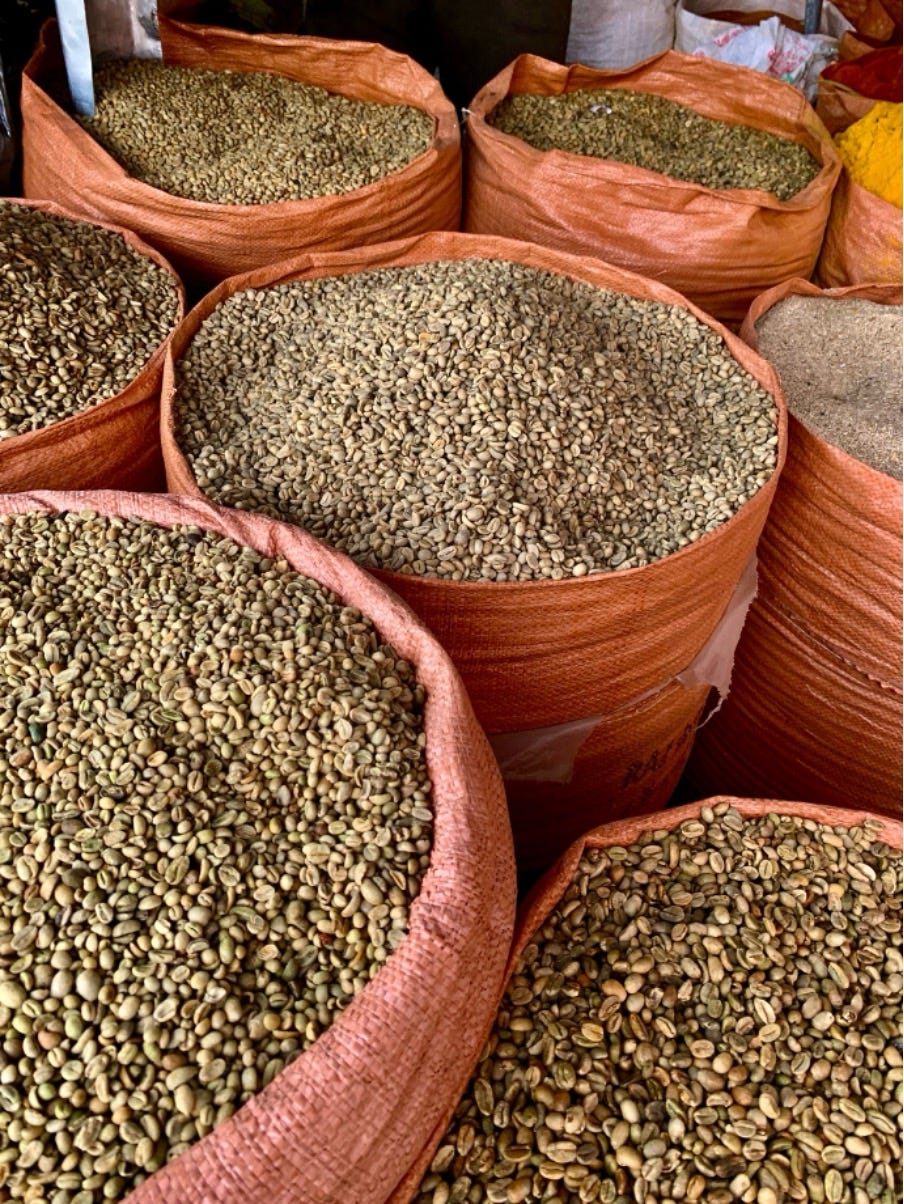
We believe that plants are passive. They do not move, so they are not ‘animated’. However, we now know that plants communicate through microbial networks in the soil. They are engineers who calculate the angle of the sun. They are survivors; they remember the drought of years ago and prepare for the next one. They faithfully follow the calendar and change form with the changing seasons. They are life manifesting in a continuous transition. I have come to believe that plants are conscious and sentient, so I talk to them.
Why do we feel a pang of guilt at the slaughter of a cow but not at the harvest of a carrot? Perhaps because the cows look back at us. However, the plant is doing something equally radical; it is turning light into matter. It is a miracle we have learned to ignore because it occurs in the dirt. Animals resemble us. Plants do not, but they are alive, and through their lives, they sustain us.
To the best of our knowledge, plants do not experience pain. However, they respond to physical damage and environmental stressors. Many plants have sophisticated systems for detecting touch, light, danger, and if one is to believe experiments on the Venus flytrap, they can count too. Plants can’t vocalise. They reproduce in abundance and sometimes thrive when cut and drop their fruit on ripening. Eating plants does not feel the same as eating animals.
The Gospel of Matthew speaks of the mustard seed, a tiny speck that dreams of becoming a forest. And Wendell Berry, that patron saint of the furrow, reminds us that “The soil is the great connector of lives.” Seeds are the bridge between life and death. You can keep it in a jar for years, but it has a plan to come alive when the conditions are right.
Pick up a seed, any seed. A sunflower, lentil, or stray bean from a winter garden.
Hold it in your palm and feel its weight. It feels like a stone, but it is actually an antarbhava. Within this small mineral-like thing lies the possibility of a green explosion, which will produce many more copies of itself and continue as life as long as it meets the right conditions. Henry David Thoreau wrote, “What is the use of a house if you haven’t got a tolerable planet to put it on?” Seeds remind us that existence is relational; they do not live alone but rather in dialogue with soil, fungi, sunlight, and water.
Every day, we walk over millions of these “not-yets.” We live in a world that is constantly trying to change. The miracle is not just that the seed grows; the miracle is that it waits. It knows how to remain still until the world is ready for it.
Look at the seed again. It isn’t a thing. In a world full of endings, a seed is a promise of another beginning. The five beans are in my jar. They look like stones. But somewhere inside them a spring is already rehearsing.
All pics by the author