

“We are too often blind to the intelligence of animals because we are trapped inside our own definitions of what intelligence looks like.” From Are We Smart Enough to Know How Smart Animals Are? by Frans de Waal.
“Every animal lives in its own perceptual world, rich with meaning, even if that is inaccessible to us.” From An Immense World by Ed Yong.
This is a story about animals giving gifts.
About Socks
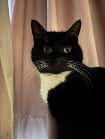
Socks is our tiny, extremely cute, and very anxious cat. Like all our cats, Socks is also a rescue. Socks will not go near anyone or let anyone touch her, pat her, or carry her except my middle daughter, Emilia.
Emilia is the animal whisperer of the house. She can bond with any animal anywhere and under any circumstances. Once we were deep in the forests of Costa Rica and she stopped by a bush and said, “Dad, there is something here.” I tried very hard, but I could not see anything. My daughter lifted a leaf, and underneath it was a glass frog.
Glass frogs are miniature marvels of nature. They have transparent muscles and skin, and their internal organs are contained within a mirror-like sac that reflects light.
My daughter has a sense of animal presence in her vicinity that I cannot fathom. In the middle of Bandhavgarh Forest in Central India some years back, we had stopped for a rest. Suddenly, scores of beautiful yellow butterflies descended upon her, as if she were a nectar-laden bloom.

She can gently hold fireflies, lizards, slugs, and snails, creatures small and large. They are drawn to her. I have dreaded lizards since childhood. The Punjabi word for lizard is kordkilli. Kord also means leprosy. Once, when I was a child, a lizard fell on my hand and shed its tail. For months, I feared that I would contract leprosy. Emilia taught me not only how to handle lizards but also to see the magic in their reptilian bodies.


My older daughter has the same animal sense and empathy. She grew up largely with her mother, and I only recognised her abilities when she was older and spending more time with us. My mother and maternal grandmother were equally attuned with animals around them. Perhaps it runs in families, not just from shared nurture but also as a shared nature.
Socks bearing gifts
Socks spends all her time on my daughter’s bed or in her lap. Mostly she is out.
Every few days, Socks brings a kill to the house. It is usually a vole. She doesn’t eat them. I do not know how she kills them, but she leaves them outside our bedroom doors. I do not think she leaves them in any particular arrangement. But of the three occupied bedrooms, she leaves one at the door of each one, Emilia being the biggest recipient of her gifts.
My wife and I feed her in the morning, but she has not allowed us to get near her. She watches from a distance while we put the food down and scuttles away if we approach. Thus, the gift cannot be in return for food, for we feed her, but Emilia gets the largest share of gifts.
Socks sometimes meows softly outside the bedroom door, announcing her arrival with a gift. Only Emilia is awake during those hours, and Emilia tells us that Socks is her friendliest and most playful when she is found with her gift. She seems delighted.
Perhaps Socks delights in giving gifts and witnessing them being received.
Why do Cats bring gifts?
The gift may be bonding behaviour rather than being merely transactional. Socks may think she is our mummy and is teaching us how to kill. Or Socks may think that we are not competent enough hunters and may not be able to provide enough food, so is replenishing the family store of food. Whatever the explanation, Socks must feel like she is part of our family. Even though she will not let me near her.
There is a significant gap between the Socks’ intent and my interpretation of it. Perhaps that gap will remain unbridgeable until Socks starts speaking English or Punjabi, or I start speaking ‘Catese’.
Animals and gifts
I read recently that squirrels will adopt orphaned relatives if they lose their mothers. Research shows that red squirrels only adopt pups that are closely related to them, such as siblings, nieces, nephews, or grandchildren. Male squirrels are well known for bringing gifts to females.
I have spent many years making my bird feeders squirrel-proof. From my window, I can watch a squirrel get up on its hind legs and examine each new impediment or obstacle I have put in place for it to not reach the bird food. It rubs its front paws. I can feel the force of the squirrel’s intense focus and thought. It is thinking. I know it in my bones that the squirrel is thinking, just as I know I think. The squirrel consistently defeats me and gets the food.
I, a professor at one of the UK’s top universities, am regularly defeated in a test of intelligence by the humble squirrel.
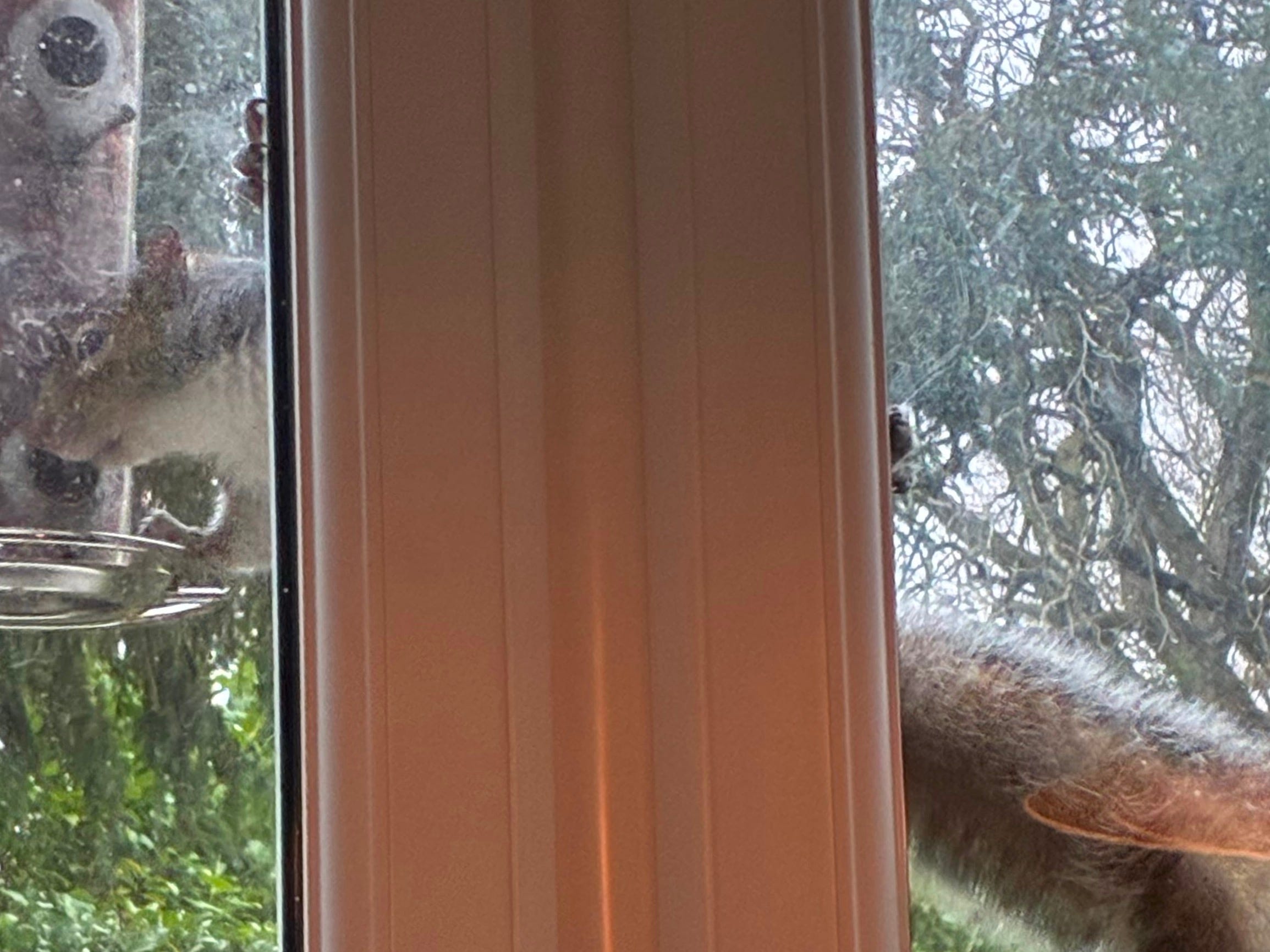
I have stopped placing obstacles. If you cannot beat them, invite them to the table. Currently, both birds and squirrels feed from the same source.
Ravens bring ‘treasures’ such as shiny pebbles or bottle tops to humans who feed them. Male penguins propose by offering the smoothest pebble to the female. Some male nursery web spiders wrap their prey in silk as a ‘wedding gift’ for their mates. Many other species, such as wolves, dolphins, and ants bear gifts. Hyenas will regurgitate food to a superior as a sign of submission, like paying taxes to a king.
Does each species have the same intention?
What is a gift?
A gift is love made palpable; an offering that carries the warmth of one hand into another. Perhaps it began when our ancestors shared food or fire–a spark of trust in a dangerous world requiring group protection. The gift turns me into we. The practice endures because it feeds what is finest in us: the wish to be seen, to belong, to weave gratitude and care into everyone’s story. Gifts can express hierarchy, love, reciprocity or represent what words cannot articulate. If gifts are social signals, then giving and receiving a gift requires not just instinct, but an embodiment of the relational aspects of being.
Finding Highway on a highway
We get our rescue cats from Argos sanctuary in Cyprus, where a group of dedicated, mainly English women look after stray cats. We found a cat there called Highway.
Highway was so called because he had been found near dead next to a main road. Somebody had shot him, and some pellets were still lodged near his spine, so he walked with a funny gait, but he was a truly loving cat. The moment we saw him at the sanctuary, we all fell in love with him.
My son, the youngest in the family, was against bringing Highway home to England because of the effect on Socks. In a democratic vote, he lost three to one, and we got Highway airlifted to our house.
Our son turned out to be right. Socks vanished, refusing to return for several months, while Highway stole our attention and affection.
Highway was a lovely, curious, and affectionate creature. He is the only cat who made me love cats. I am a dog person. I like my affection to be reciprocated. I want the dog to tell me that he knows I am Daddy. Cats don’t do that. They are too proud, snooty, and indifferent for my liking.
Till I met Highway. He forced me to carry him and insisted that he sit on my lap and that I stroke his head or body. I realised that cats love humans too and both give and seek affection, but differently from dogs.
Highway died while exploring the road outside and was run over. We were heartbroken. One of the reasons we’ve had animals since our kids were born is that we think it’s important for children to have pets, understand the roles and rules of caring for others, witness the cycle of life and death and learn how to grieve and let go.
Miraculously, Socks reappeared a few weeks after Highway died
Animal communication
How did Socks know that Highway was gone? We have discussed this as a family many times. We have no explanation.
There was no sign that Socks was coming furtively to the house to check for the presence of Highway. Might there be a cat gossip group or a cat WhatsApp group? If cats have a gossip group, Socks would certainly not be part of it. She is too skittish to be near another cat.
So how did she sense it? Telepathically? I don’t know. Smell? Or another sense we know nothing about.
And I don’t think we can know.
We can see the love of a dog in the dog’s eyes. It feels like human love. This is not anthropomorphisation. Anyone who thinks it is, does not understand the nature of love. Love is a quality of emotion, not a quantifiable object that can be dissected atom by atom to prove its existence or its equivalence between humans and other species.
Why we fail?
We are too blind to the natural world. Our definitions of intelligence, sentience, and consciousness are too narrow. Our intelligence is far too limited to understand animal intelligence.
Everybody I know loved the documentary My Octopus Teacher. But you don’t have to go deep into the ocean to find animal intelligence. It is in the ants crawling on your windowsill. In the Robin that is right now at my bird feeder. In the vole that is sometimes alive when Socks brings it in. Socks releases it from her jaws and the vole scurries to hides in the tiniest space it can find beyond her reach. We lock Socks in another room and gather around the terrified vole, attempting to capture it for release. The tiny vole, almost dead with dread, still ususally manages to beat the four of us. There is intelligence in the smallest creatures you can see, and even smaller ones. Under the slide, you can see the single-celled amoeba avoiding toxins. They not only move away from harmful substances but are also known to possess sophisticated biological mechanisms for detoxifying their environment. Intelligence does not require size, only the force of life. It exists from the smallest living thing to the mightiest one you might encounter in a jungle or in the ocean.
Animals as gifts
We need to look at animals with awe and reverence. Perhaps animals, too, are gifts from nature’s benevolent hand, living reminders that the sacred wears many forms. Somewhere along the way, we placed ourselves on a throne above them, citing divine dominion and mistaking stewardship for superiority. In our quest to get closer to God, we have drifted away from the breathing tapestry of life around us. Other, older ways of knowing, such as those of my grandmother, saw things differently. She spoke to beasts and thanked trees, knowing that all life hummed with the same spark. We share the same breath, and no creature has a greater right to being than another.
The Isah Upanishad of Hinduism tells us that “the wise sees the Self in all beings and all beings in the self”(verse 6).
Let us be wise. Let us cherish these gifts. Love, protect and provide for them all, not just our pets.
Thanks Karen. I don';t know enough about human intelligence except to be certain it is not a single dimension. Much easier to write about human folly. :-). But I will try
Thank you for this. Growing up we lived in the country surrounded by many animals and always had dogs and cats. I think as an adolescent I realised I did not have the patience for dogs. But I always respected the independence of cats. I am not sure what this means. The part about squirrels reminded me of this https://www.youtube.com/watch?v=hFZFjoX2cGg&list=PLgeXOVaJo_gl1ZIpbYyPRXzQner7-5j5k&index=1 - You are not alone in the squirrel appreciation.